Drawing proper chair conformations of cyclohexane is one of the skills you will need throughout your Organic Chemistry 1 and 2 classes.
The main component of the chair conformation is, well, the chair-like structure of the cyclic structure. There are two chair conformations, which are mirror images of each other:

The next part of mastering drawing chair conformations is the proper orientation of the hydrogen atoms or any other groups that may be in their place. These are divided into two groups: axial and equatorial positions:

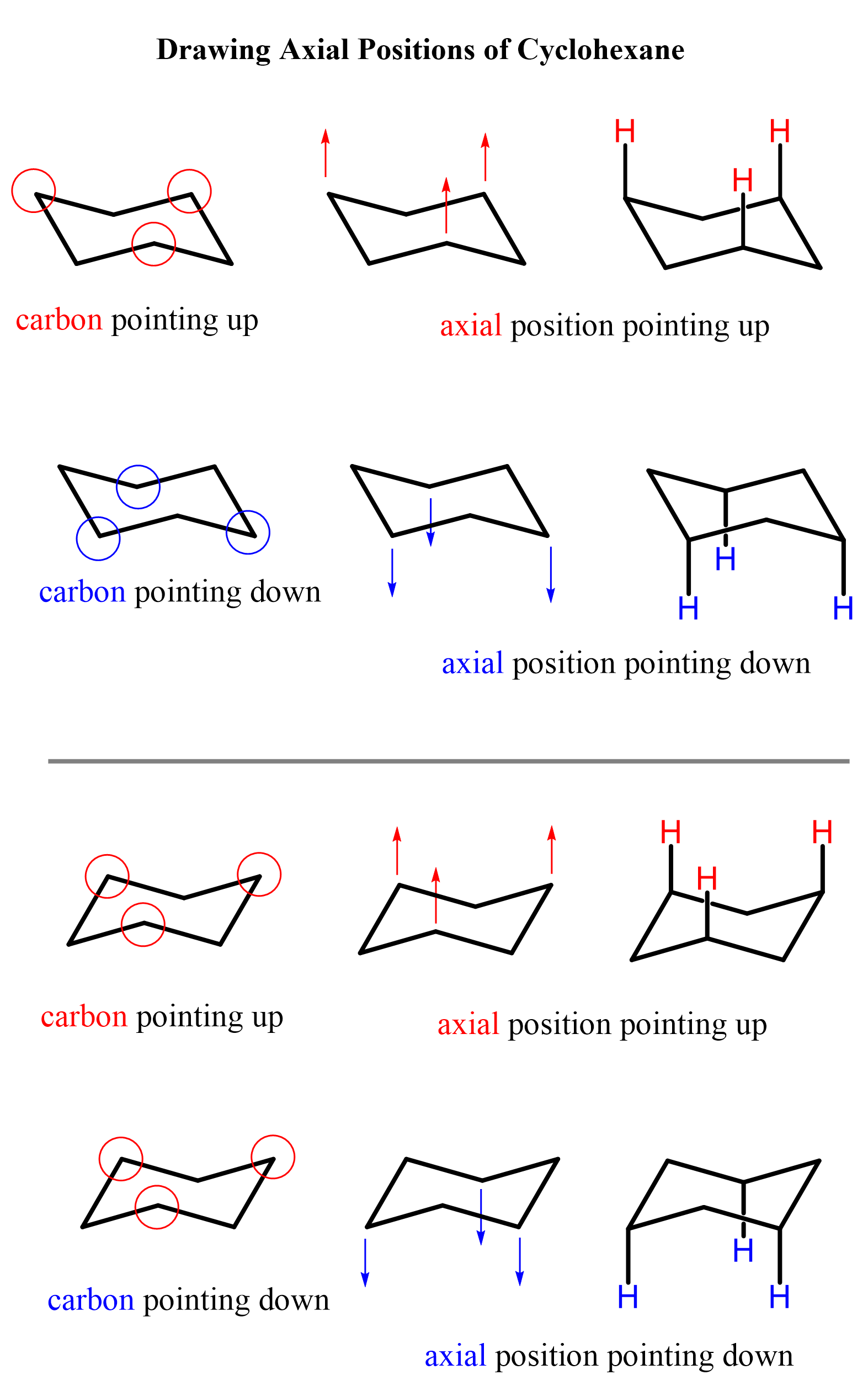
Notice that the axial groups are pointing either straight up or straight down. In a way, they are perpendicular to the ring surface, and the only mistake you may be making here is mixing up whether the given hydrogen must be pointing up or down. Remember, all the carbon atoms in cyclohexane are sp³-hybridized, and for the way we draw the chair conformation, the axial groups are aligned with the carbon atoms they are connected to.
What we mean is that whenever the carbon atom is pointing up, the axial group is also pointing straight up, and whenever the carbon is pointing down, so does the axial group connected to it:
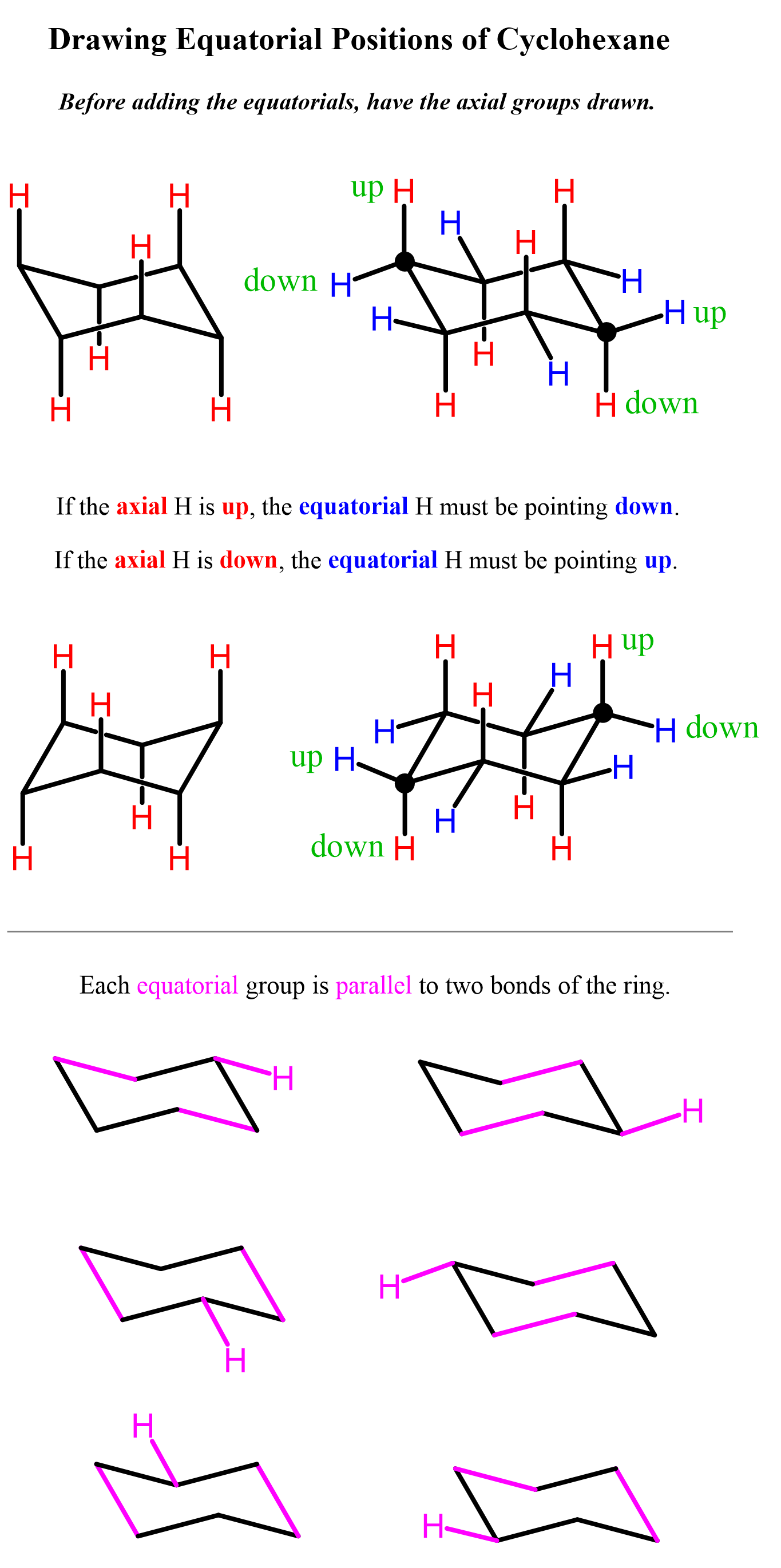
Once the axial groups are added, we can now show the equatorial hydrogens. The equatorial groups are pointing to the sides, and each of them is parallel to two carbon-carbon bonds:
A common mistake that students make is the wrong direction of the equatorial groups. They still show them to the sides, but the requirement of pointing to the correct side is quite strict too:
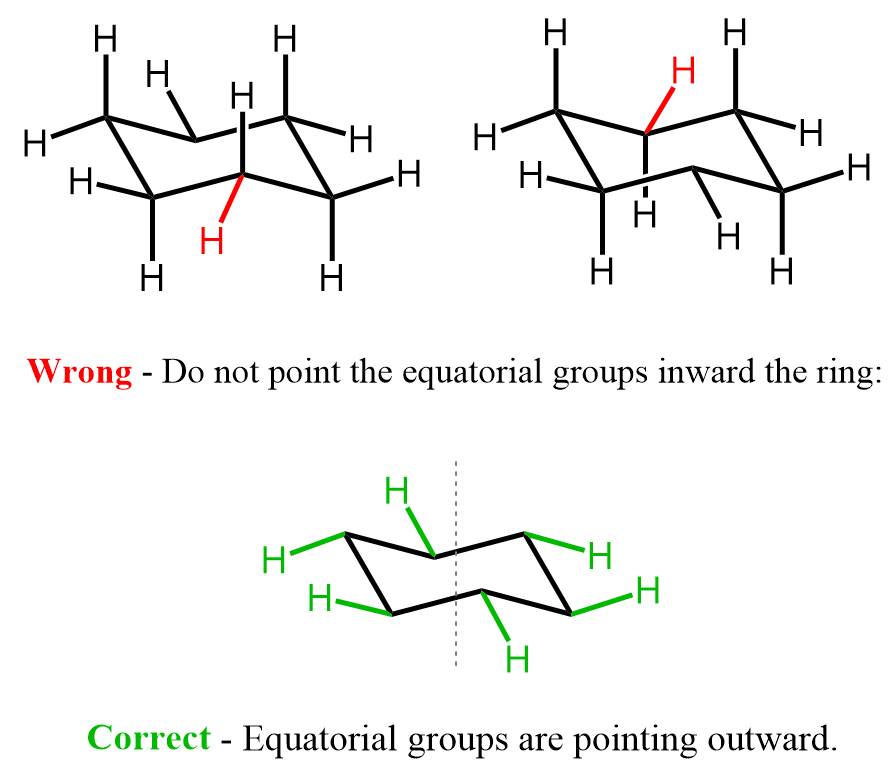
So, remember, the ones on the right side of the ring must be pointing to the right, and the ones on the left side of the ring must be pointing to the left.
Flipping from Axial to Equatorial Position
As mentioned earlier, all the carbon atoms in cyclohexane are sp³-hybridized and connected with single bonds. Recall from the structure of alkanes and their conformational analysis that there is free rotation about single bonds:

Now, this rotation is not entirely free in cycloalkanes because the ring brings some restriction to the movement of the atoms, but as much as it allows, cycloalkanes are still able to adopt different conformations. Cyclohexane changes its conformations, and the two most stable ones are generally the two chair conformations.
What is important is that during this change of conformations, which we also call a ring flip, all the axial groups become equatorial, and all the equatorial ones become axial:

Here is also a short video that demonstrates the ring flip of cyclohexane:
Here is also a short video clip for better visualization of the chair forms with the bond angles and perspectives:
It is important to note that despite the flip from axial to equatorial, the group retains its relative orientation. So, if a group is pointing up in the axial position, it will be pointing up in the equatorial position of the flipped chair conformation. The same goes for the equatorial groups, regardless of whether they are pointing up or down. Up stays up, and down stays down.
To demonstrate this important principle, consider the ring flip of (1R,3R)-3-chlorocyclohexan-1-ol:

In the first conformation, the OH is equatorial, pointing up, while the Cl is axial, pointing down. The ring flip changes the OH to axial and the Cl to equatorial, and they are still pointing in the same direction they did in the first chair conformation. Once again, we discuss the details of drawing the ring flip of the chair conformation in this article, so feel free to check it out as well.
The Stability of Axial and Equatorial Positions
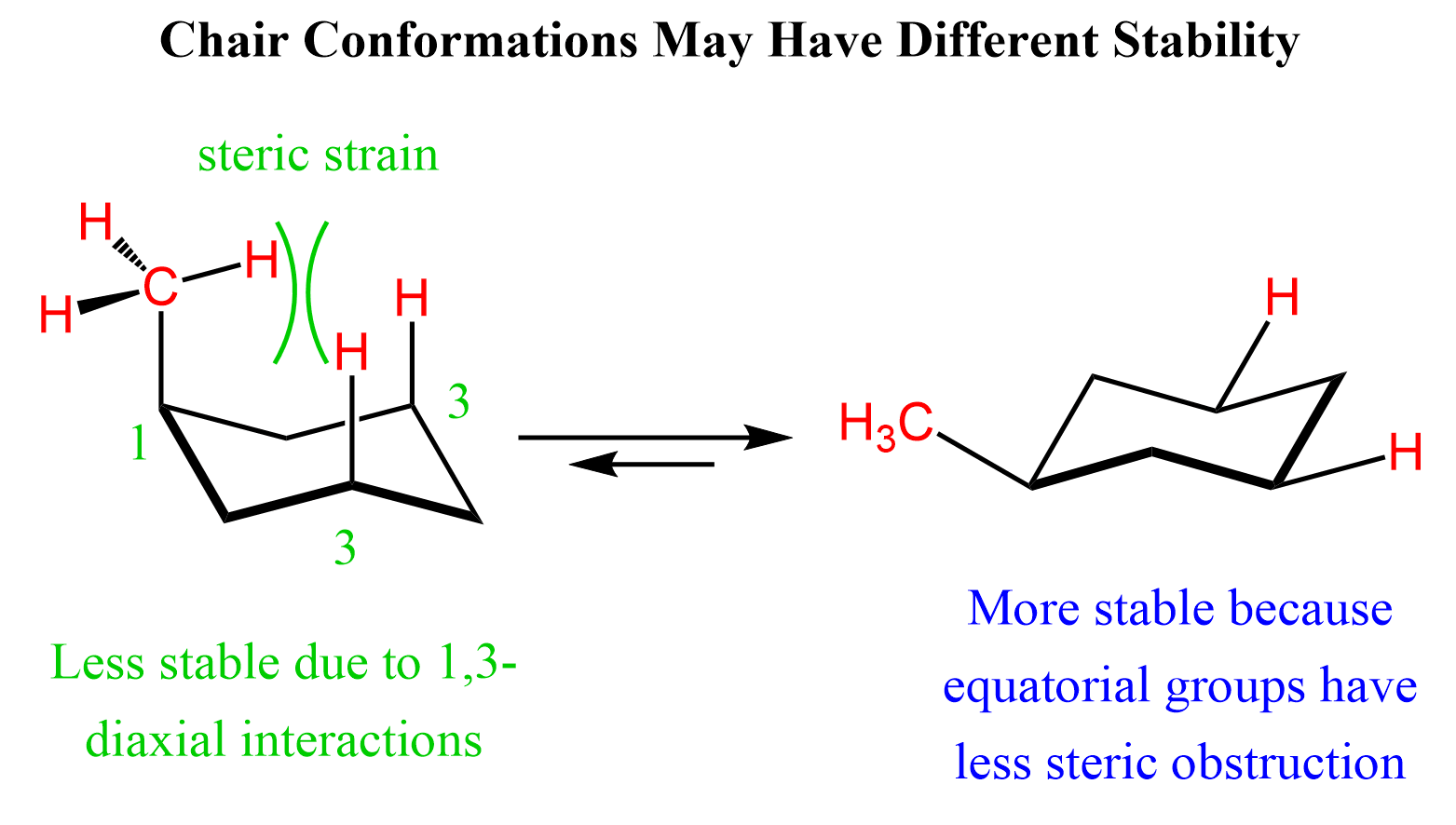
The axial position is energetically less favorable because of the 1,3-diaxial interactions between the given group and the other axial groups that are three carbon atoms away. For example, the two chair conformations of methylcyclohexane are not energetically equivalent because when the methyl group is in the axial position, it experiences unfavorable 1,3-diaxial interactions with the axial hydrogen atoms on the same side of the ring. As a result, the conformation with the methyl group in the equatorial position is more stable and is therefore favored at equilibrium:
The 1,3-diaxial interaction is actually a gauche interaction between the methyl group and the CH2 group in the ring.
Let’s see how that happens. If we convert the chair cyclohexane to its Newman projection, we can see that the methyl group has a gauche interaction with the CH2 group just like in butane:
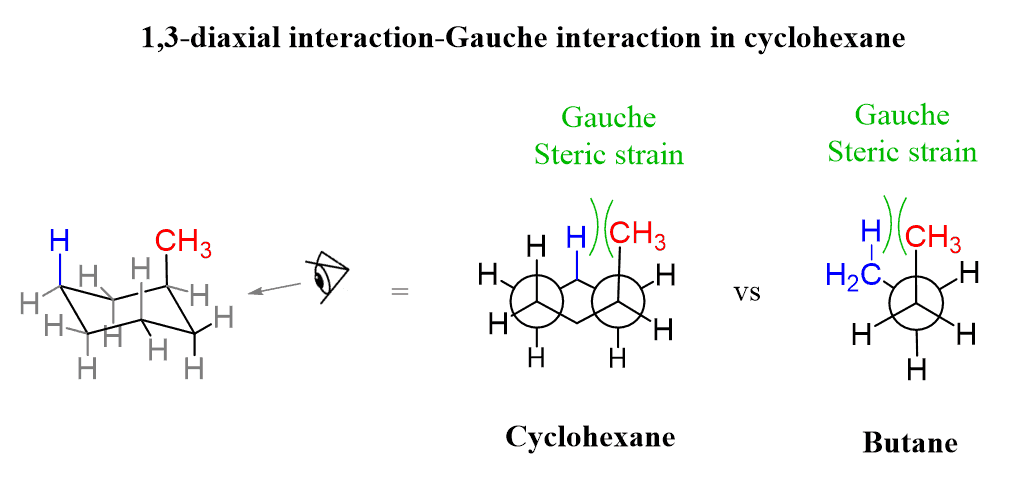
The second gauche interaction can be seen by looking from the bottom left corner:

So, the 1,3-diaxial notation is the most common way we refer to the gauche interactions of axial groups in the chair conformations. Generally, the axial conformation of a given cyclohexane is less stable than the corresponding equatorial conformation.
The 1,3-diaxial interaction is a type of steric obstruction, meaning the groups are fighting for space, which brings some unfavorable energy to the molecule. This also means that the larger the group, the worse it is to place it in the axial position. The energy values of the 1,3-diaxial interactions of the most common groups are shown in the following table:

A values
We can assess the stability of chair conformations quantitatively by comparing which ones are in the axial and which ones are in the equatorial positions.
However, the actual energy difference of the conformations is calculated by the Gibbs free energy formula:
ΔGo = – RT ln Keq
And using the ratio 95:5, it is calculated that this corresponds to 7.28 kJ/mol. So, the equatorial conformation is more stable than the axial by 7.28 kJ/mol. This energy difference is known as the A value, and it varies depending on the axial group.
The larger the group, the higher the energy difference. For example, the energy difference of the axial ethyl cyclohexane with the equatorial conformer is 7.3 kJ/mol:
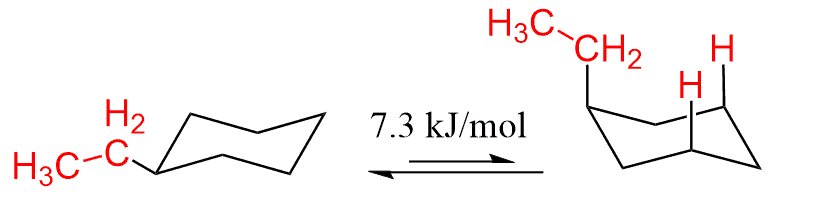
This is interesting because the ethyl group has an additional methyl, and you may expect that it should bring a significant steric strain (more than 0.02 kJ). However, because of a free rotation around the single bond, the methyl points away from the ring, thus reducing the steric strain:

Axial and Equatorial Groups in Disubstituted Cyclohexanes
A common question in this topic is drawing the chair conformations of disubstituted cyclohexanes, comparing their relationship and stability. For example, you may be asked to draw the conformations of cis– and trans-1,2-dimethylcyclohexane and compare their relationship and stability. To do this, you will need to convert each bond-line representation to the corresponding chair conformation and compare their stability based on whether the methyl groups are in axial or equatorial positions:
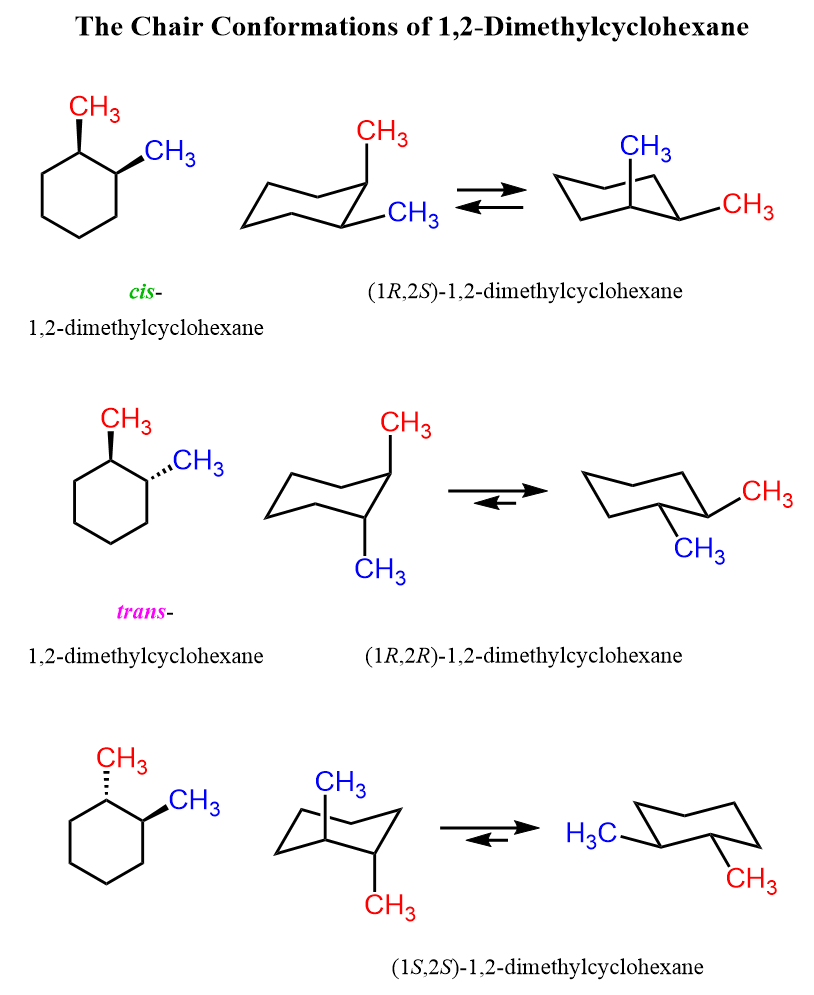
Notice that for the cis isomer, the two chair conformations are of equal stability because each conformation has one axial methyl group and one equatorial methyl group. However, for the trans isomer, the two chair conformations have different stabilities because one conformation has two axial methyl groups, while the other has two equatorial methyl groups. The diequatorial conformation is therefore more stable than the diaxial conformation.
The isomerism and stability of disubstituted cyclohexanes are quite comprehensive and require a separate post, which you can find here.
We can assess the stability of chair conformations quantitatively by comparing which ones are in the axial and which ones are in the equatorial positions.