
We have seen many nucleophilic addition reactions to aldehydes and ketones, including those of amines. So, when we imagine an amine reacting with an aldehyde or ketone, we immediately recall the C=N bond, which implies formation of an imine, also known as a Schiff base.
Well, this is true when a primary amine is reacted with aldehydes and ketones. When a secondary amine is used, the product of the reaction is an enamine, which is a compound containing a C=C double bond directly attached to a nitrogen atom:

To understand why we have different products when primary and secondary amines are used, we need to look at the mechanisms of these reactions. Let’s put them next to each other and see where the difference arises.
They both start with a nucleophilic attack of the nitrogen on the carbonyl group, forming a tetrahedral carbinolamine (hemiaminal) intermediate. This intermediate then undergoes proton transfers followed by dehydration, leading to the formation of an iminium ion intermediate:
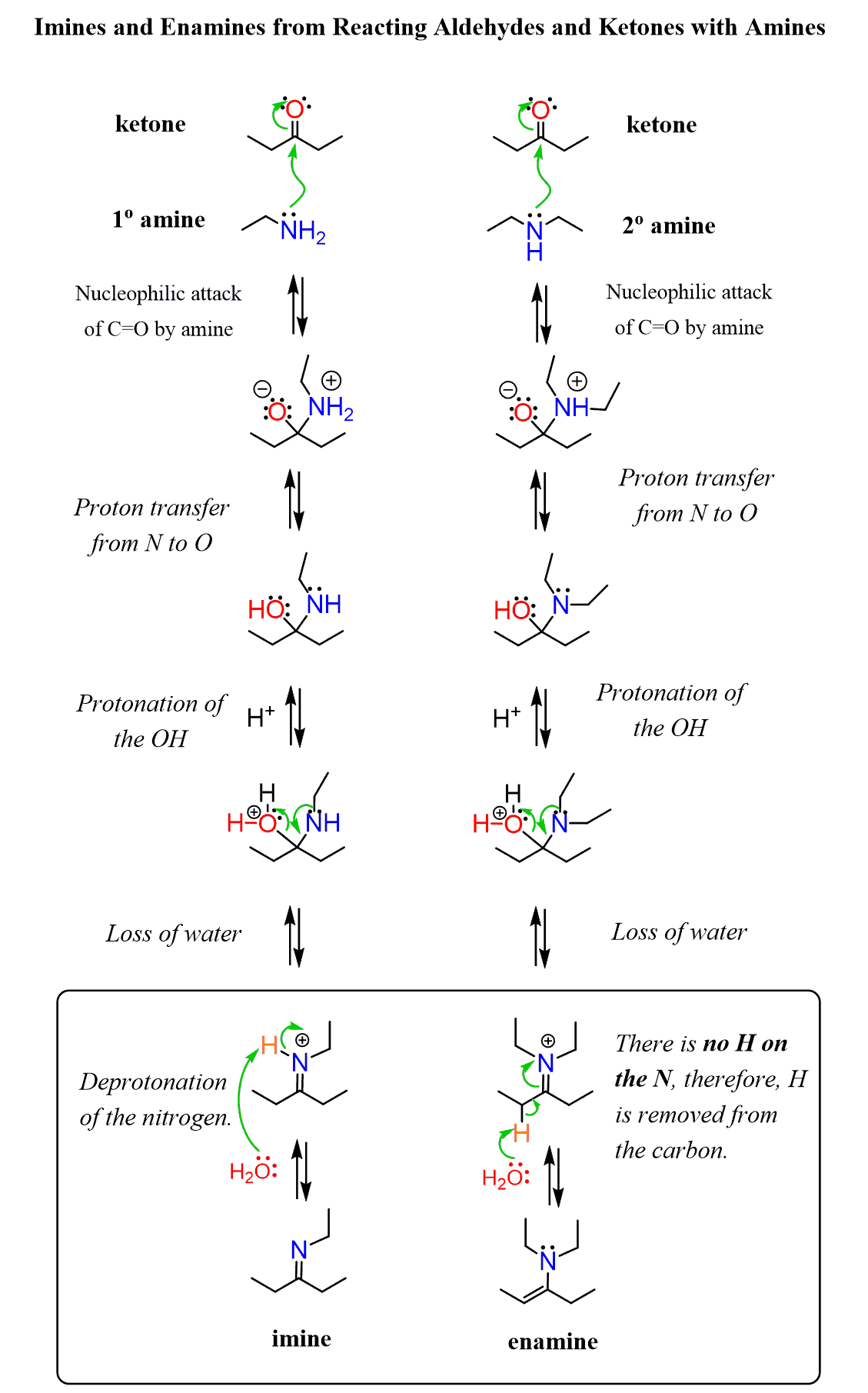
Once again, notice that up until the last step of deprotonation, everything is the same. The only difference is that in the case of secondary amines, there is no proton left on the nitrogen, and the only way for it to get rid of the positive charge is through elimination of an α-hydrogen. This forms a C=C double bond and pushes the electrons of the C=N double bond onto nitrogen, resulting in the formation of an enamine.
Let’s emphasize this deprotonation step to visualize better how the imine and enamine are formed when a primary or secondary amine is reacted with aldehydes and ketones:

Although the examples shown above are on ketones, you need to know that aldehydes also produce enamines when reacted with secondary amines.
We have an entire post on the reactions of amines with aldehydes and ketones that covers all of this, with more examples, lots of practice problems, and much more, so be sure to check it out as well.
Check Also
- Nomenclature of Aldehydes and Ketones
- How to Name a Compound with Multiple Functional Groups
- Preparation of Aldehydes and Ketones
- Nucleophilic Addition to Carbonyl Groups
- Reduction of Aldehydes and Ketones
- Reactions of Aldehydes and Ketones with Water
- Reactions of Aldehydes and Ketones with Alcohols: Acetals and Hemiacetals
- Acetals as Protecting Groups for Aldehydes and Ketones
- Formation and Reactions of Imines and Enamines
- Reductive Amination
- Acetal Hydrolysis Mechanism
- Imine and Enamine Hydrolysis Mechanism
- Hydrolysis of Acetals, Imines, and Enamines: Practice Problems
- Reaction of Aldehydes and Ketones with CN, Cyanohydrin Formation
- The Wittig Reaction: Examples and Mechanism
- The Wittig Reaction: Practice Problems
- Aldehydes and Ketones to Carboxylic Acids
- Reactions of Aldehydes and Ketones – Practice Problems
- Aldehydes and Ketones Reactions Practice Quiz
- Reactions Map of Aldehydes
- Reactions Map of Ketones
- Reactions of Amines Practice Problems