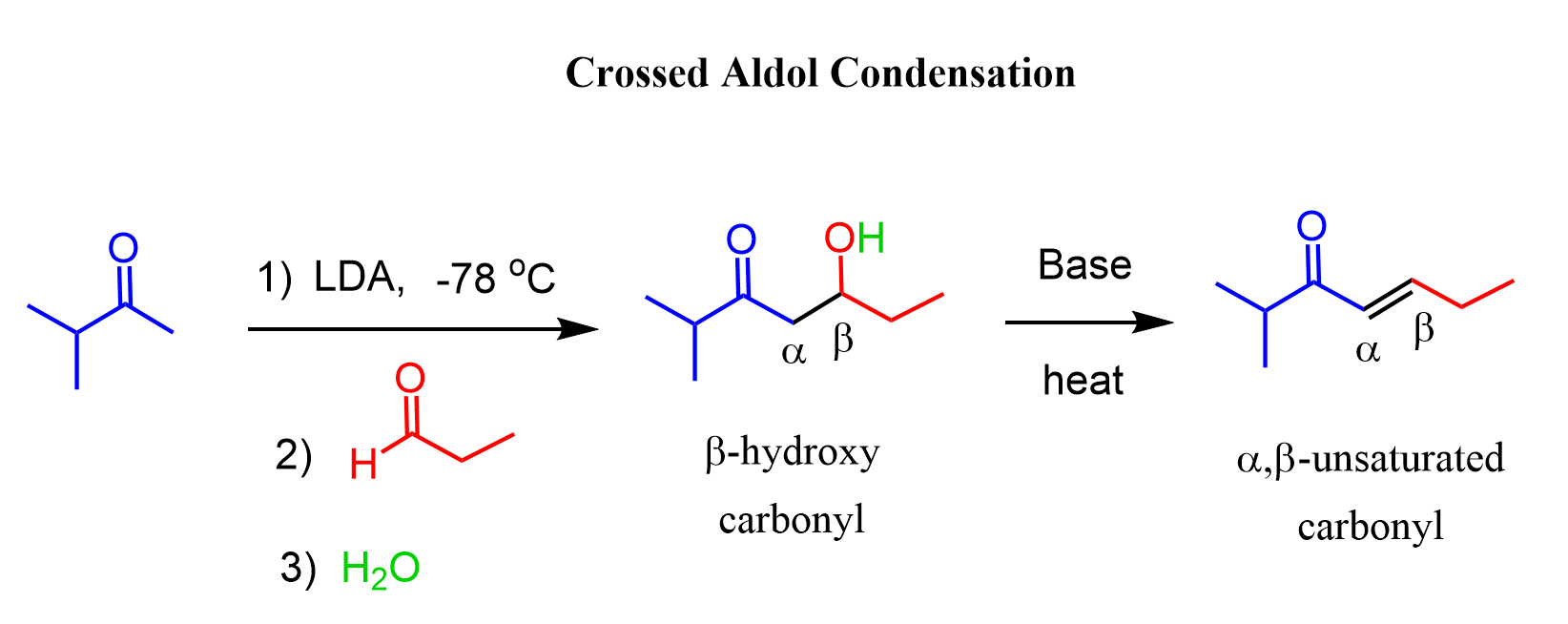
Remember when discussing crossed aldol reactions, we saw that they occur between two carbonyl compounds, one of which is first converted into a nucleophile through deprotonation at the α-position. The product is typically a β-hydroxy carbonyl compound, which can further undergo dehydration via E1cB elimination to give an α,β-unsaturated carbonyl compound:
These types of reactions are not restricted to carbonyl compounds serving as the resonance electron-withdrawing group. Other functional groups containing an alpha hydrogen next to an electron-withdrawing group can also stabilize the negative charge and allow the formation of a nucleophile at the adjacent carbon.
For example, the alpha position of esters, nitriles, and nitro groups can also be deprotonated, and the resulting anion may undergo different reactions such as the Claisen condensation, alkylation of the alpha position, etc.

A quick reminder that we use LDA to prevent self-condensation of the carbonyl compounds; otherwise, if the same carbonyl compound is used, weaker bases such as NaOH can also be used.
Henry Reaction
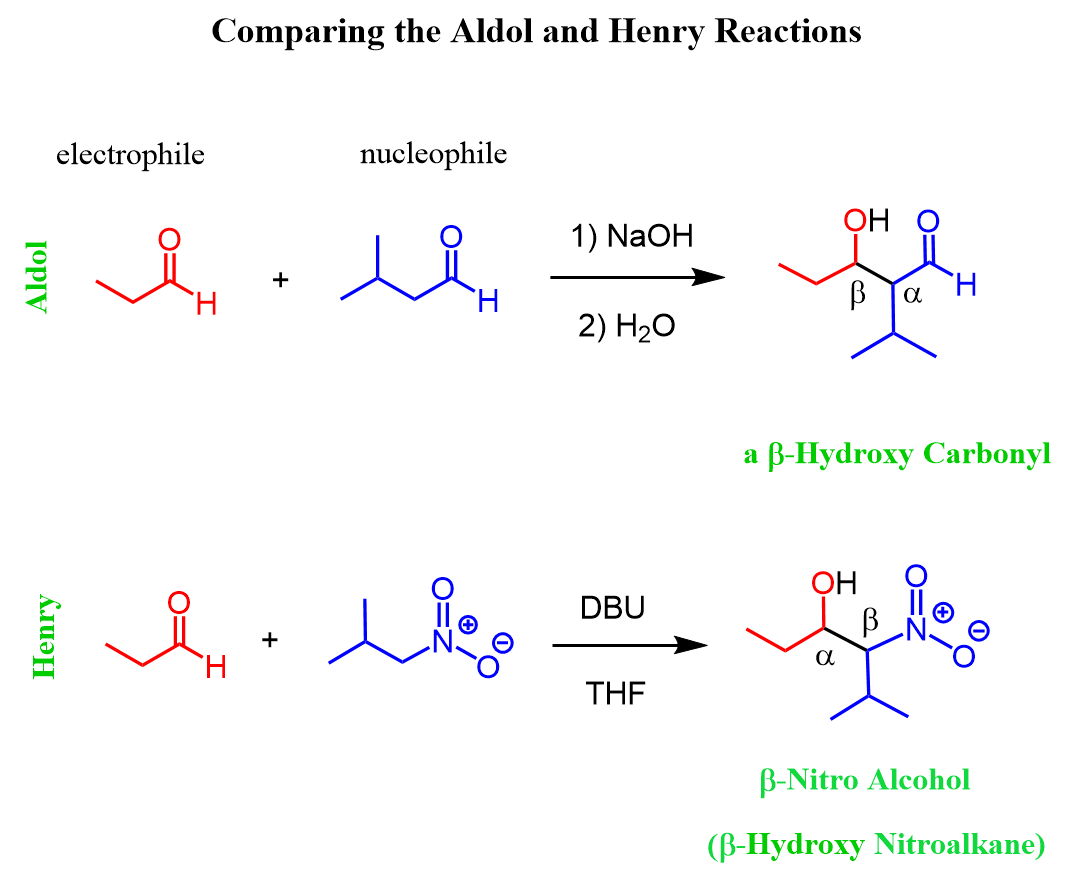
An aldol reaction where the nucleophile is a nitro group was first discovered by Louis Henry in 1895. Henry found that nitroalkanes could readily react with aldehydes and ketones in the presence of a base to form β-nitro alcohols. This reaction is now known as the nitro-aldol reaction, or the Henry reaction:
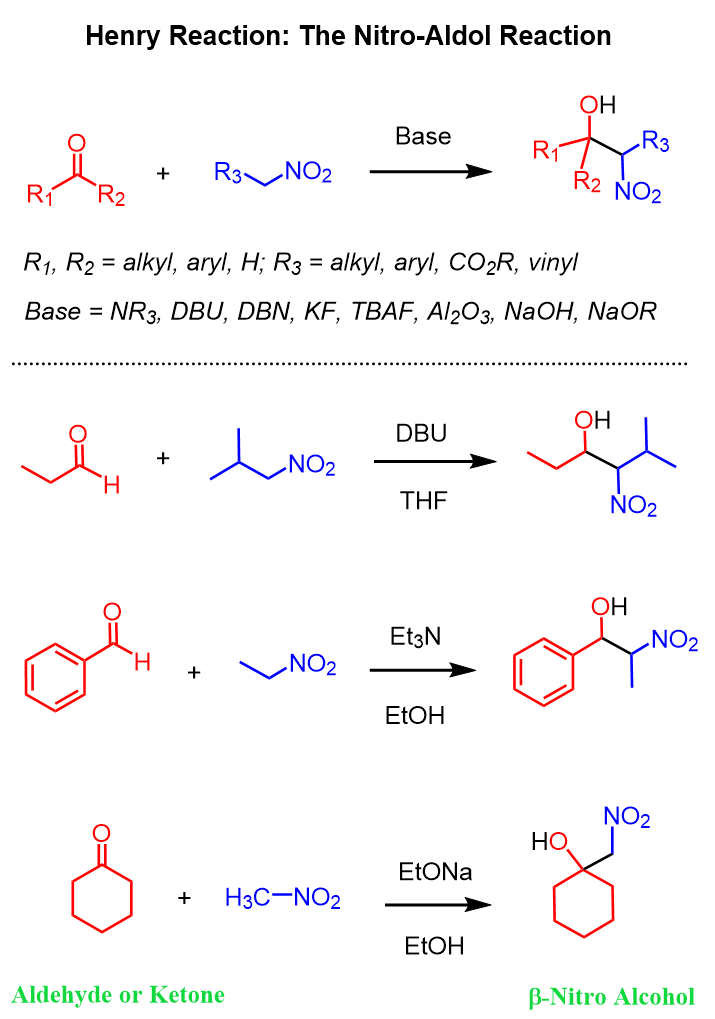
Let’s put an example of aldol and Henry reactions next to each other, so we can see the common pattern:
The Mechanism of the Henry Reaction
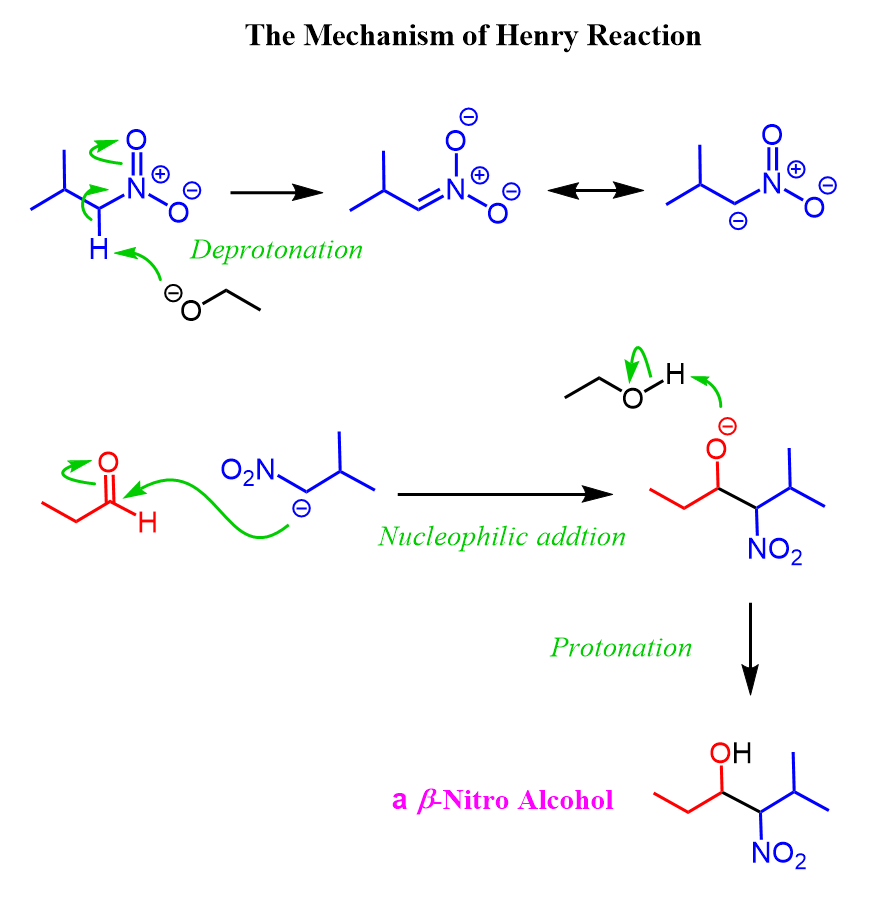
The mechanism of the Henry reaction is not much different from the aldol reaction. In the first step, the nitroalkane is deprotonated by the base at the α-position to form the corresponding resonance-stabilized anion. Next, an aldol-type reaction takes place where the resonance-stabilized anion attacks the carbonyl, forming a β-nitro alkoxide. Finally, the β-nitro alkoxides are protonated to give the expected β-nitro alcohol:
The Applications of Henry Reaction
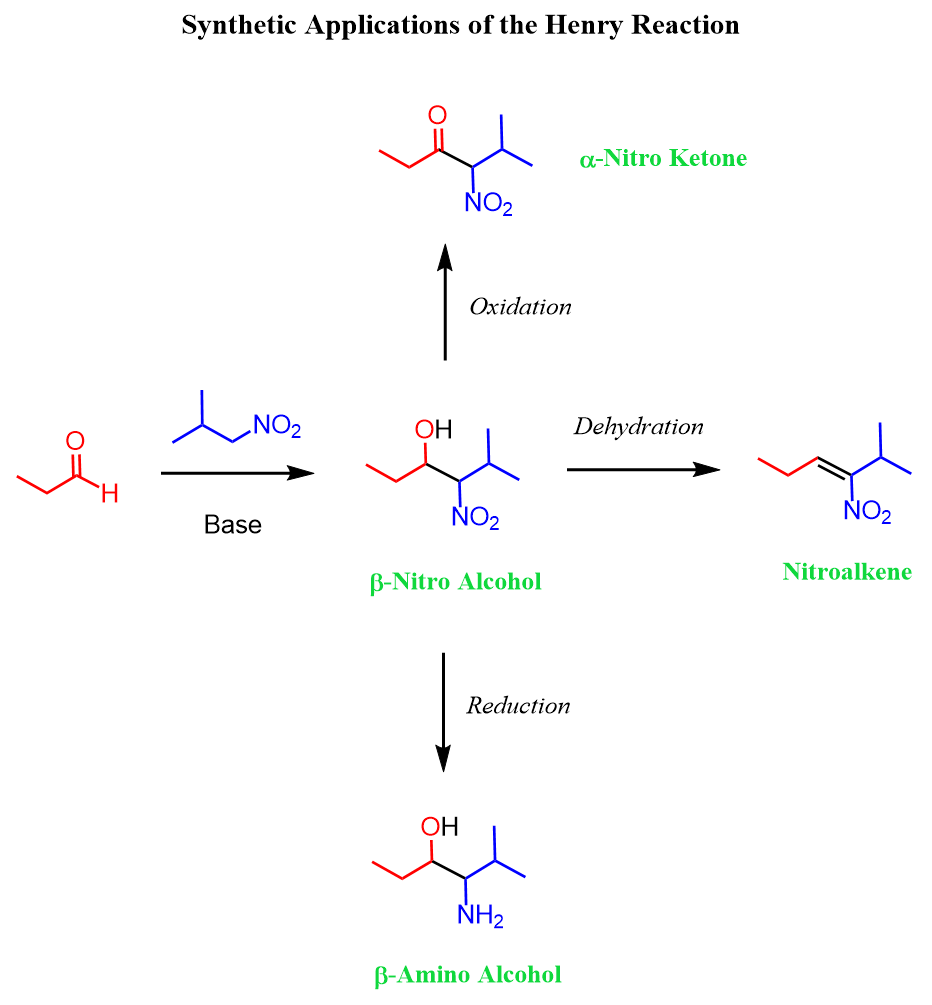
Like the products of aldol condensation, β-hydroxy carbonyl compounds, the products of the Henry reaction, β-nitro alcohols, can be dehydrated to the corresponding nitroalkenes. They can also be oxidized to α-nitro ketones or reduced to β-amino alcohols. Therefore, the Henry reaction is a versatile tool in organic synthesis, with applications in the synthesis of a variety of useful organic compounds and synthetic intermediates: