You have already learned the base names of alkanes and the IUPAC rules for determining the parent chain, substituents, alphabetical priority, and giving complete names to alkanes and alkyl halides. Here is a typical example of naming a substituted alkane, which summarizes some of these important principles:

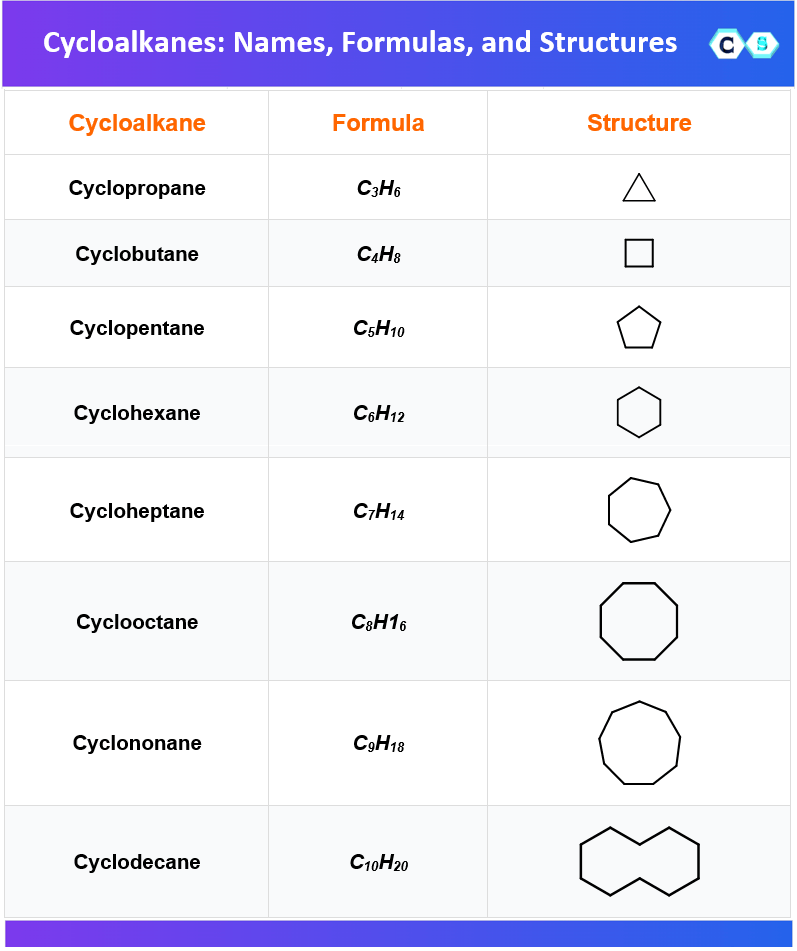
Let’s now discuss the nomenclature of cycloalkanes. Starting with the basics, remember that for simple cycloalkanes, we only need to add the prefix “cyclo” before the base name. The smallest ring is cyclopropane, and we follow the same pattern to name the rest of the cycloalkanes.
The Parent Chain and Substituent in Cycloalkanes
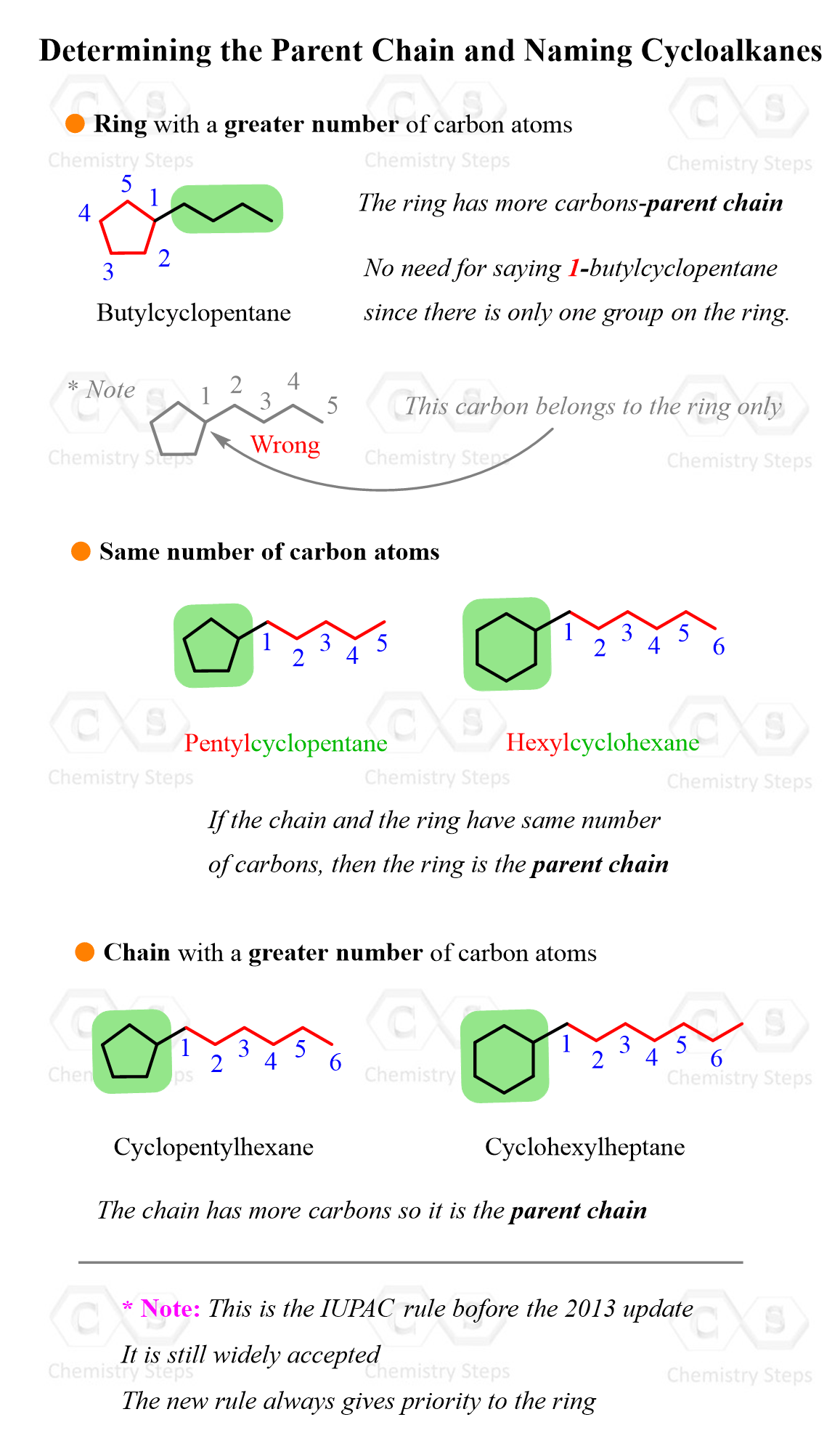
(Old/current rules) In most textbooks, the parent chain of substituted cycloalkanes is the one with the greater number of carbon atoms. For example, if we have a butyl group connected to cyclopentane, the parent chain is cyclopentane because it has more carbon atoms.
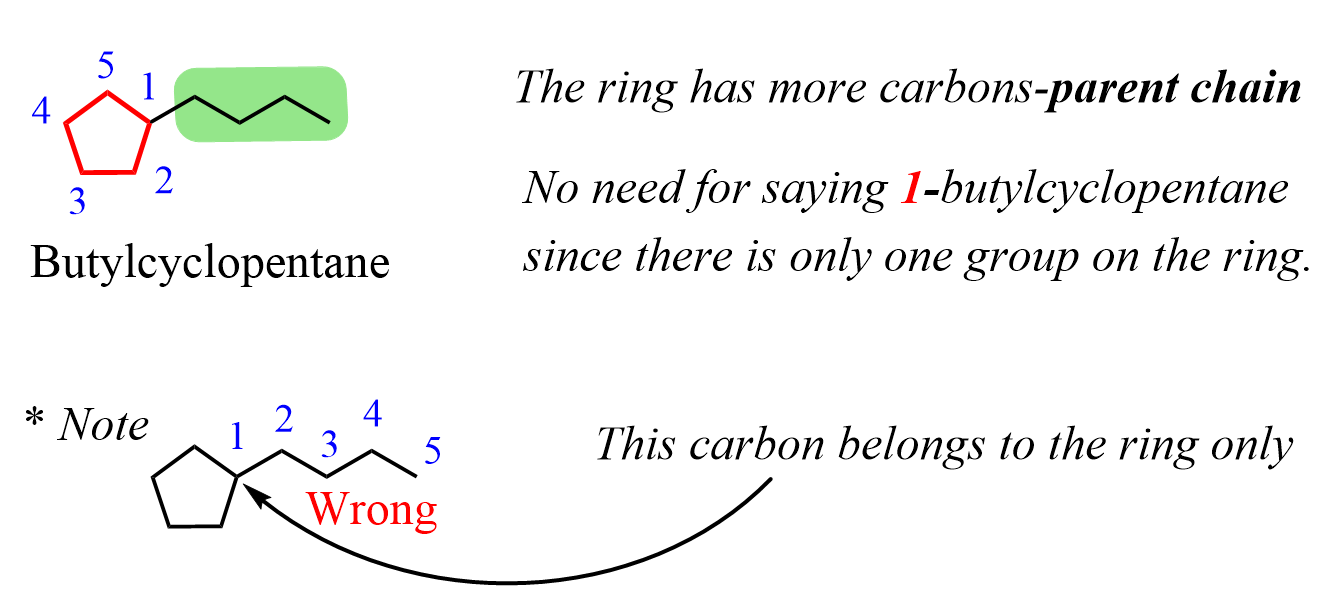
Notice that the carbon bearing the side chain is part of the ring, so we do not count it for numbering the side chain.
If the cycloalkane and the open chain have the same number of carbon atoms, the priority is given to the cycloalkane. For example, if we have a hexyl group connected to cyclohexane, the parent chain is cyclohexane.
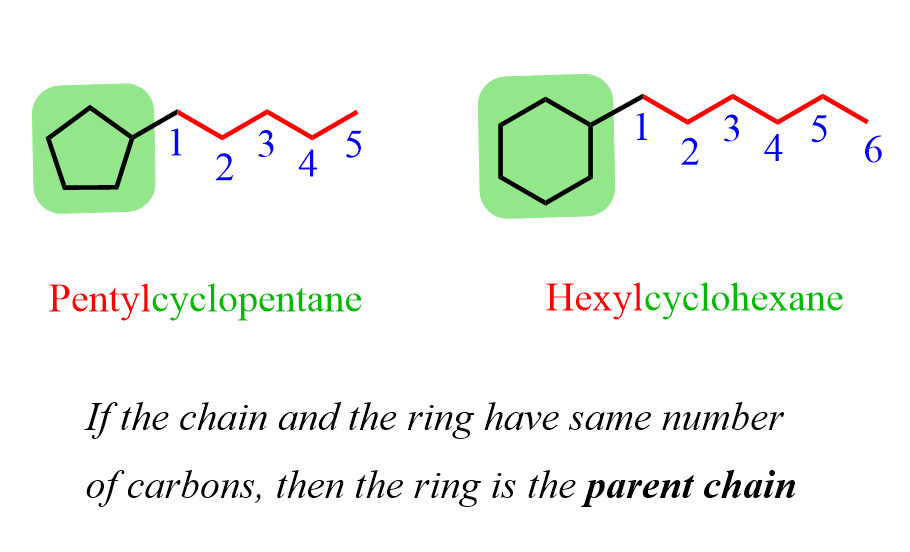
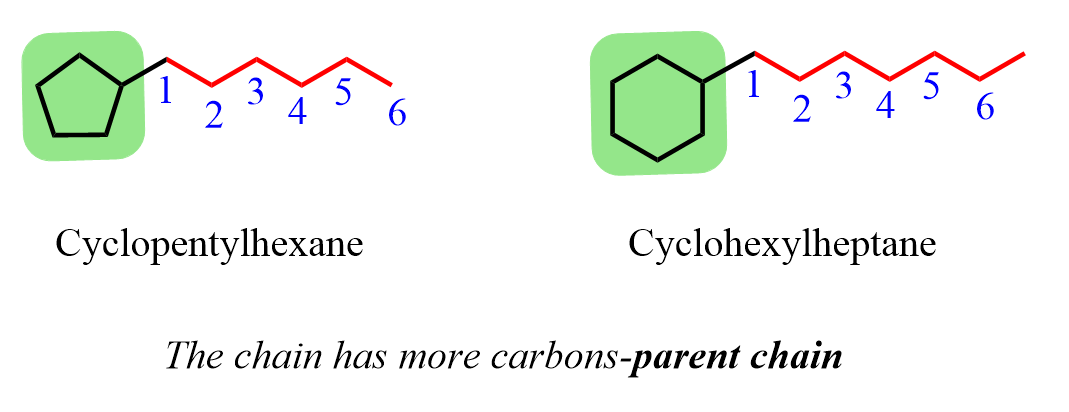
The only instance when the open chain is the parent chain is when it has more carbon atoms than the ring. For example, hexane is the parent chain when hexyl is connected to cyclopentane or a smaller ring:
So, let’s summarize these rules for determining the parent chain when the ring has a smaller, equal, or greater number of carbon atoms than the side chain:
The New Rules of IUPAC on Cycloalkanes
Since the 2013 update, IUPAC has modified the priority rules for cycloalkanes. Here is the quote from the 2013 IUPAC blue book:
P-44.1.2.2 – Rings Systems composed of rings and chains (exclusive of linear phanes). Two methods are recognized to name systems composed of rings and chains (exclusive of linear phanes). (1) Within the same class, a ring or ring system has seniority over a chain. When a ring and a chain contain the same senior element, the ring is chosen as the parent. Rings and chains are chosen regardless of their degree of hydrogenation. As a consequence, this approach prefers the choice of a ring over a chain in systems composed of cyclic and acyclic hydrocarbons.
So, what we called cyclopenthylhaexane, is now referred to as hexylcyclopentane.
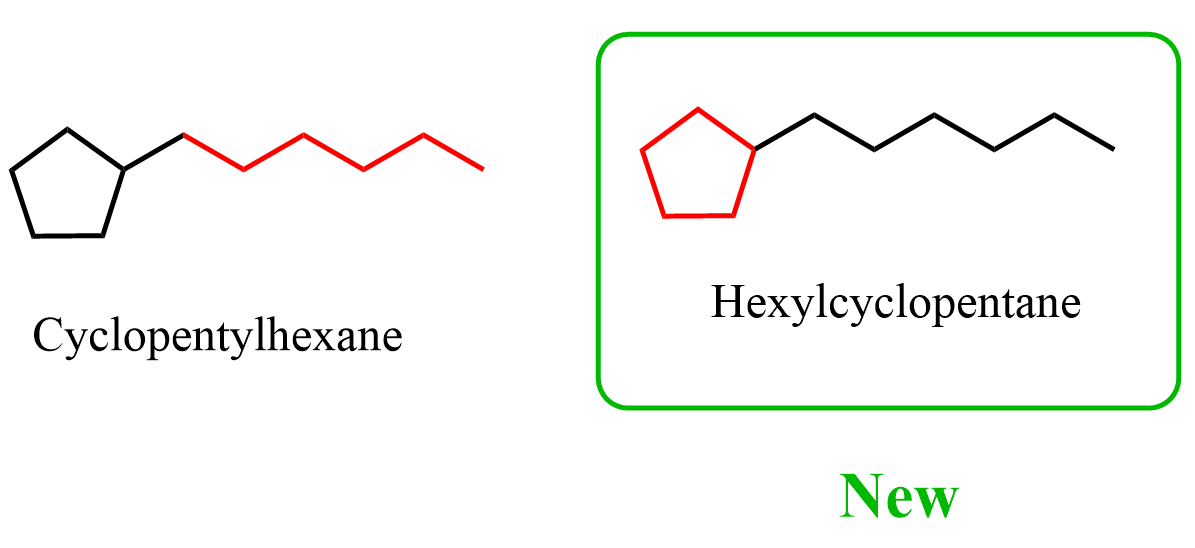
This is the preferred IUPAC name (PIN) for this molecule; however, there are some additional rules related to complex substituents and the nomenclature of alkenes and, and they are not yet substantially incorporated into the textbooks.
Please ask your instructor how they want to address these rules, but since most textbooks go with the old rules, we’ll also follow them throughout Chemistry Steps.
Numbering in the Nomenclature of Cycloalkanes
As mentioned earlier in the examples on determining the parent chain, if there is only one substituent on the ring, you can skip the locant and simply list it before the name of the cycloalkane.
If there is more than one substituent, then number them so that they get the lowest possible locants, just like we do in the case of regular alkanes. For example, the following molecule is 1-ethyl-3-methylcyclohexane, not 1-ethyl-5-methylcyclohexane:
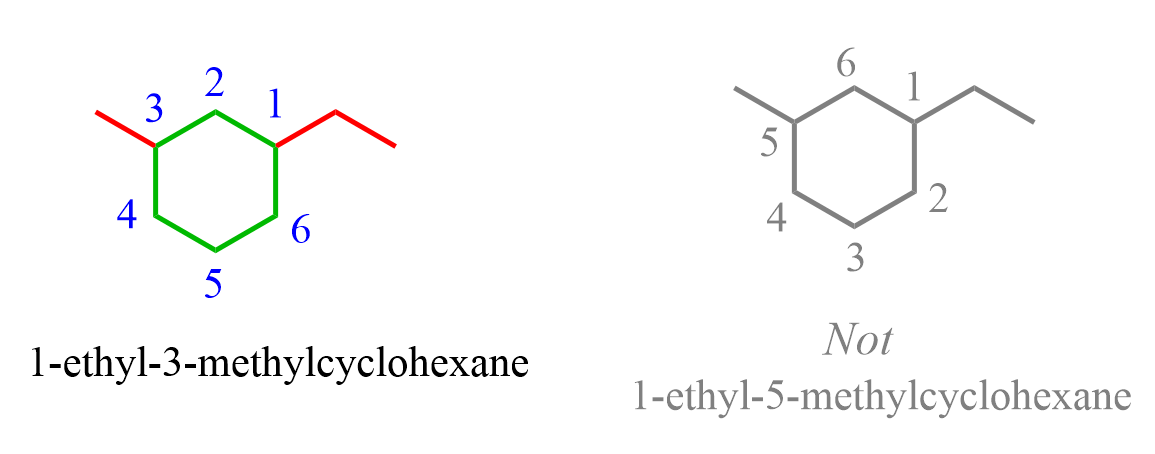
Notice that we started the numbering from the ethyl group because of alphabetical priority. So, 1-methyl-3-ethylcyclohexane gives the same locant sum, but having the ethyl in position 1 is preferred because of the alphabetical priority.
Cis and Trans in Naming Cycloalkanes
Although the cis and trans notations are mostly used for differentiating alkenes, they are also applicable to cycloalkanes. For example, if two methyl groups are pointing up and down in one chair conformation, they stay like this in the other chair conformation too, which is formed via a ring-flip:
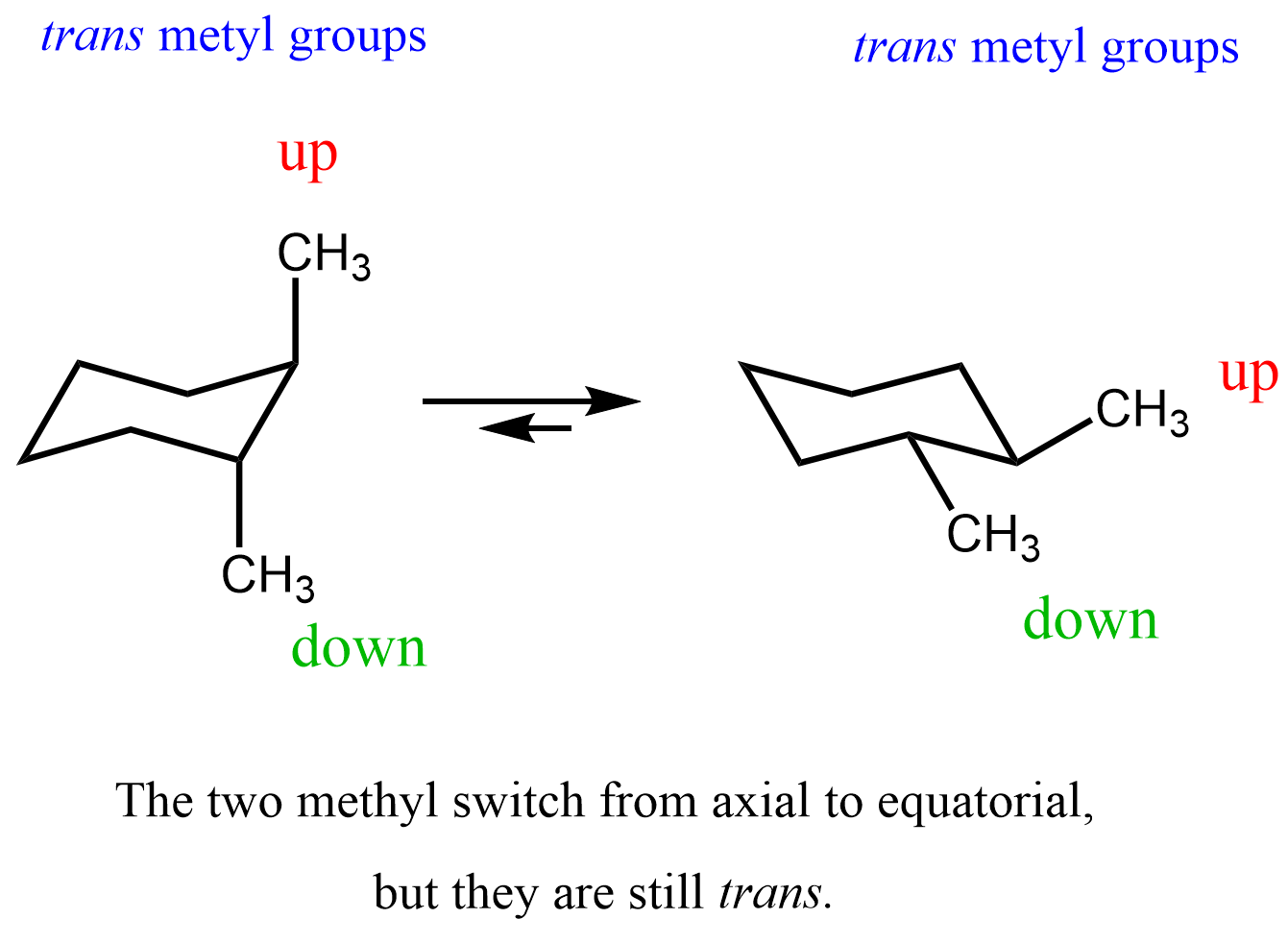
It is true that the two methyl groups switched from axial to equatorial positions; however, their relative orientation is trans.
On the contrary, we can have an isomer of this compound where the two methyls are pointing in the same direction, and in that case, we have the cis isomer.
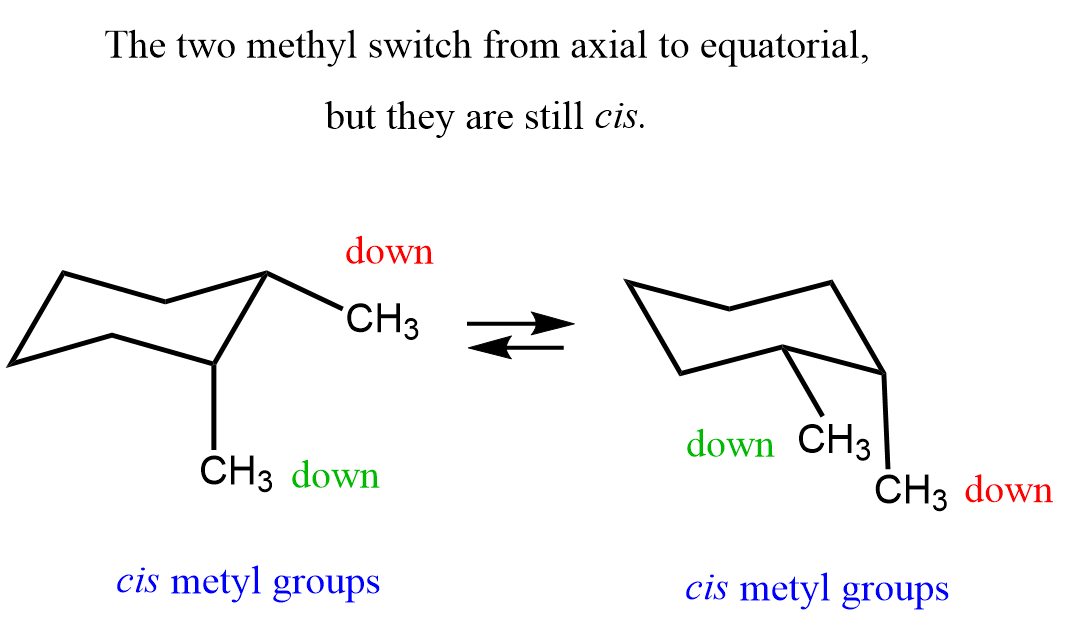
This is the cis isomer of 1,2-dimethylcyclohexane, and both configurations can also be represented using bond-line drawings for an alternative perspective.

Like in the case of alkenes, the cis and trans are used even if the two groups on the ring are not identical:

To make it easier, draw the hydrogen atoms on the carbons and determine the configuration based on their relative orientation. If both hydrogens are on the same side, it is cis, and if they are on opposite sides, then we have a trans isomer.

In a similar manner, we distinguish the cis and trans isomers of decalin, which are formed by the different relative orientations of the hydrogen atoms at the ring-junction carbons.
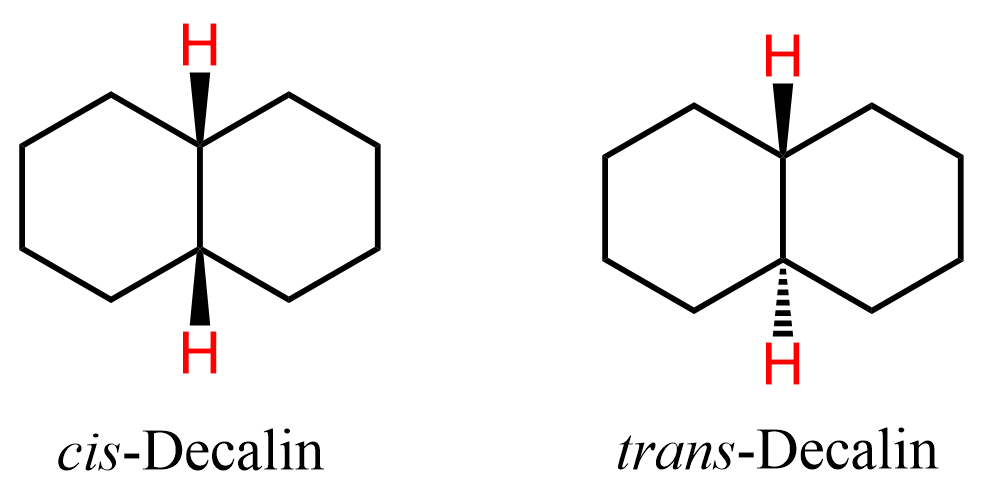
Decalins are bicyclic compounds consisting of two fused cyclohexane chair conformations. They are a particular type of bicyclic compounds, and to not make this post overwhelming, we discuss their structure and nomenclature in a separate post here.