
Negishi coupling is one of the earliest and most important palladium-catalyzed cross-coupling reactions, enabling the formation of C–C bonds between organic halides and organozinc reagents.
So, the two carbon fragments that are being coupled are an organozinc reagent (organozinc compound) that may contain aryl, vinyl, alkynyl, or alkyl groups and an organic electrophile, typically an aryl, vinyl, or alkyl halide (or triflate).
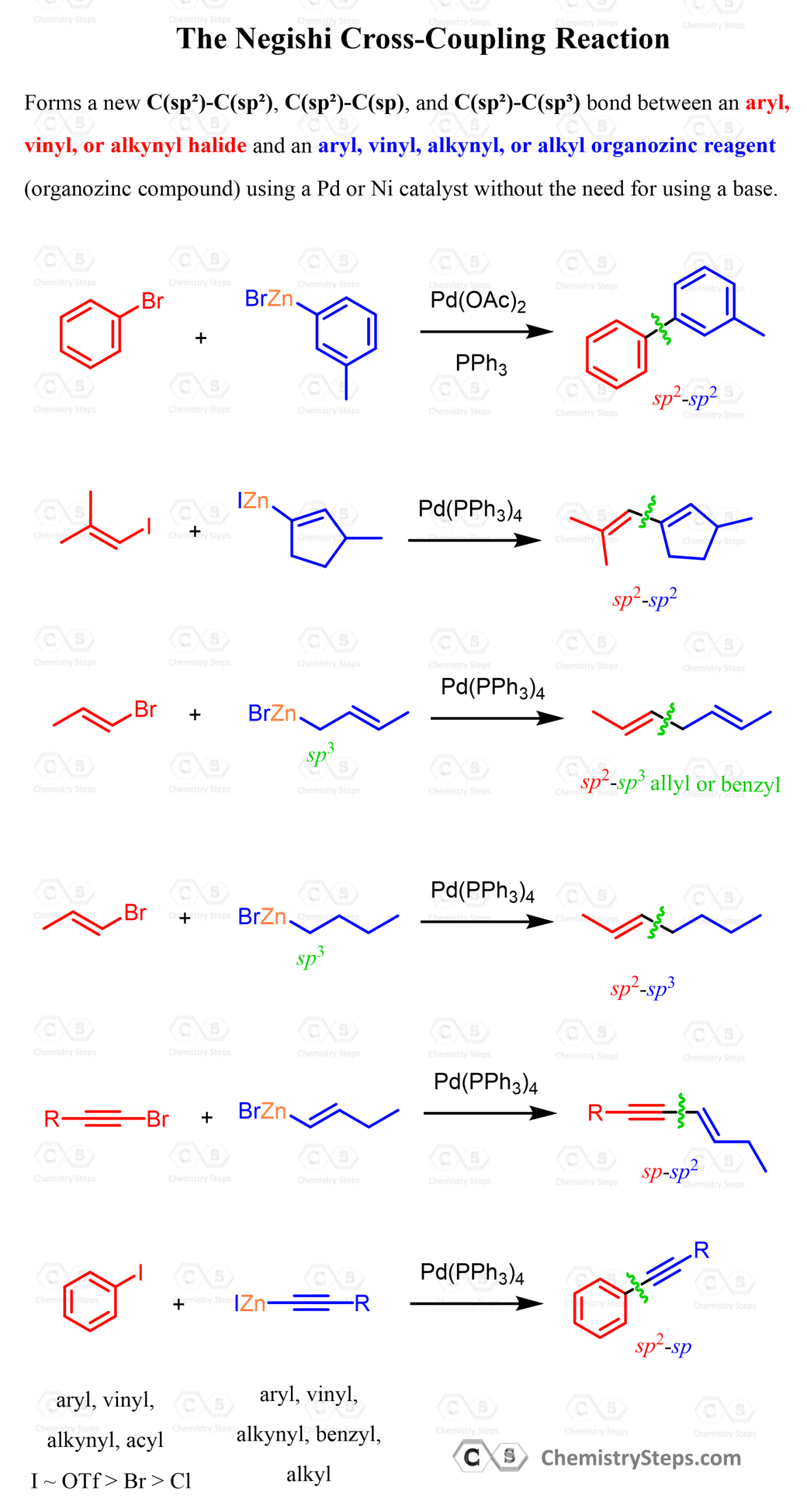
Here are some examples demonstrating how the Negishi coupling is used to form new C(sp2)-C(sp2), C(sp2)-C(sp), and C(sp2)-C(sp3) bonds:
If the terms transition metal-catalyzed and cross-coupling are unfamiliar to you, be sure to check out our introductory posts on these topics, which will make understanding the Negishi and other reactions of this chapter much easier.
For a short description, we can visualize the Negishi coupling as a 3-major-step reaction: Oxidative addition, transmetalation, and reductive elimination.
So, let’s discuss these steps in more detail to get a complete image of the Negishi coupling mechanism.
The Mechanism of the Negishi Coupling Reaction
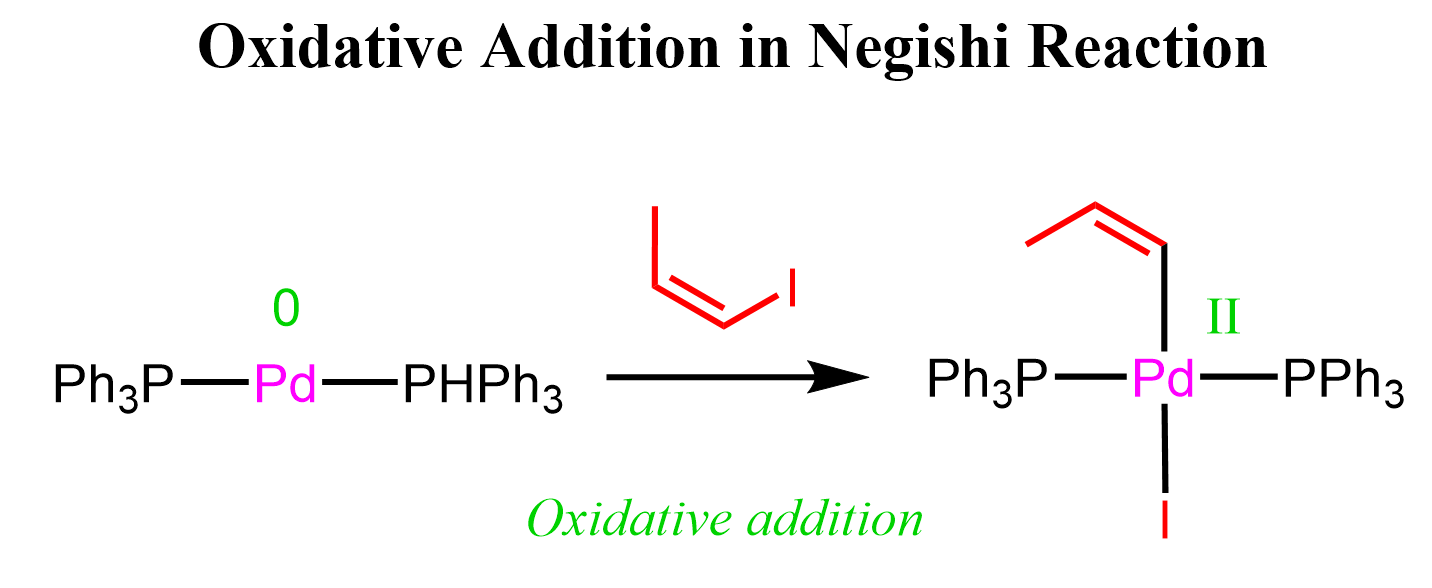
Like other palladium-catalyzed cross-coupling reactions, the Negishi coupling begins with oxidative addition, in which the palladium catalyst inserts into the C-X bond of an organic electrophile (typically an aryl, vinyl, or alkyl halide or triflate), breaking the bond and forming a new Pd-C bond:
At this point, one of the organic fragments is attached to palladium, but to couple it with the second organic partner, the second carbon fragment must also be transferred to the palladium center.
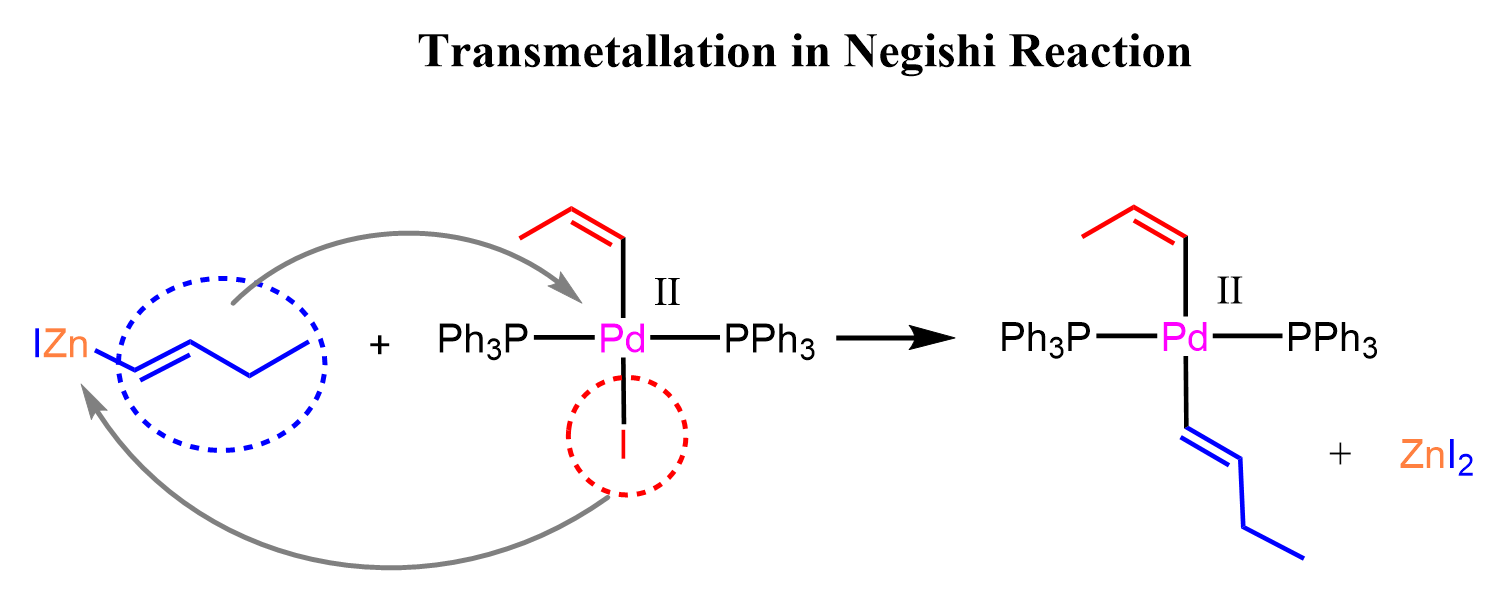
This occurs in the transmetalation step, which involves the transfer or exchange of ligands between two metals. In the Negishi coupling, the carbon fragment attached to zinc is transferred from Zn to Pd, while the halide (or triflate-derived ligand) originally bound to palladium is transferred to zinc, forming ZnX2:
The resulting palladium intermediate now contains both carbon fragments. These two groups are then joined in the final step, called reductive elimination, which forms the new C-C bond and releases the coupled product.
The term reductive elimination refers to the change occurring at palladium because, when the new C-C bond is formed, palladium loses both carbon ligands attached to it. As a result, the oxidation state of Pd decreases, meaning that the metal center is reduced:
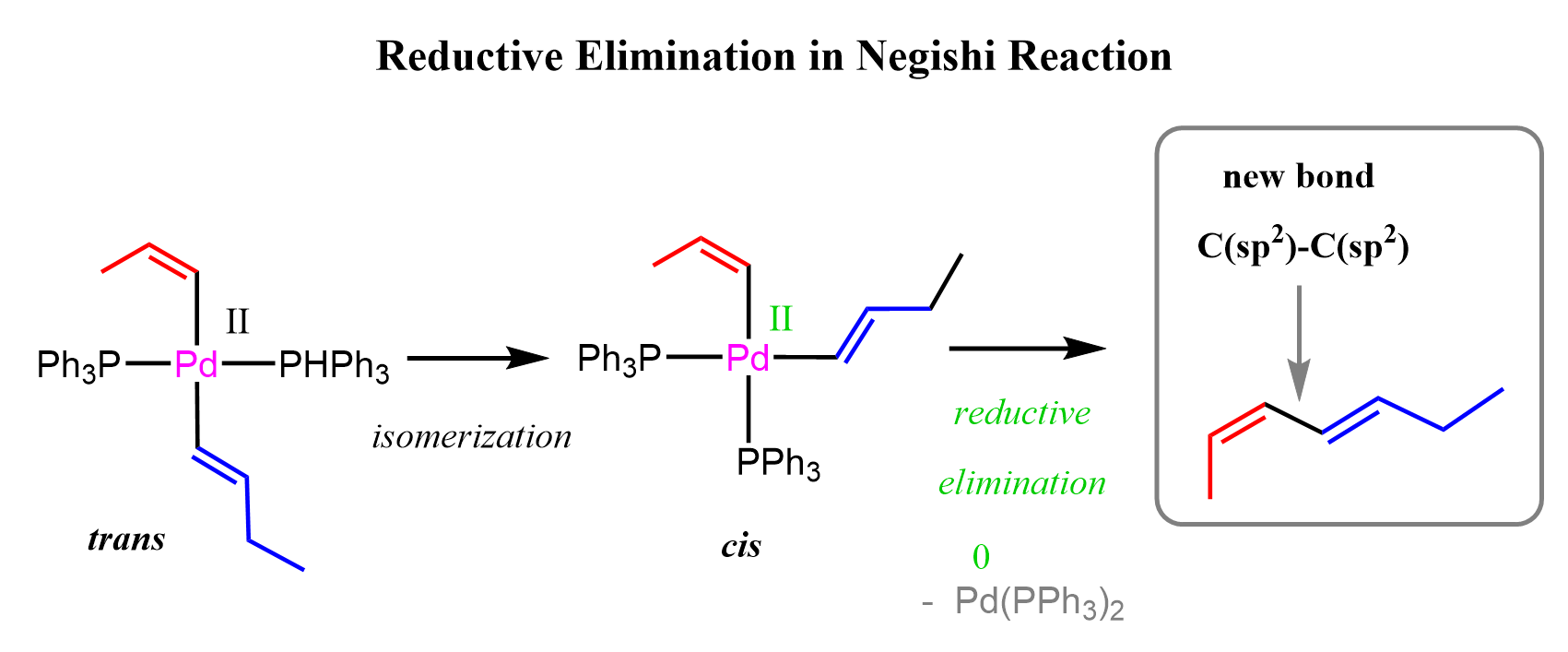
One important point about reductive elimination is the orientation of the two carbon groups attached to palladium. For C-C bond formation to occur, the two carbon ligands must be positioned cis to each other.
In the cis arrangement, the two carbon groups are close enough to interact and form the new bond. If they are arranged trans to each other, the distance between them is too great, making reductive elimination much less favorable or preventing it from occurring directly. During the catalytic cycle, the palladium intermediate can adopt the required cis geometry through cis-trans isomerization before undergoing reductive elimination.
The Catalytic Cycle of the Negishi Coupling Reaction
So, let’s put all these steps together to show the complete mechanism of the Negishi reaction in a conventional manner used for cross-coupling reactions, which is the catalytic cycle. A catalytic cycle is a simplified representation of the sequence of steps that a catalyst undergoes during a reaction. It shows how the catalyst is transformed through different intermediates, performs its function, and is eventually regenerated so that it can continue another reaction cycle:
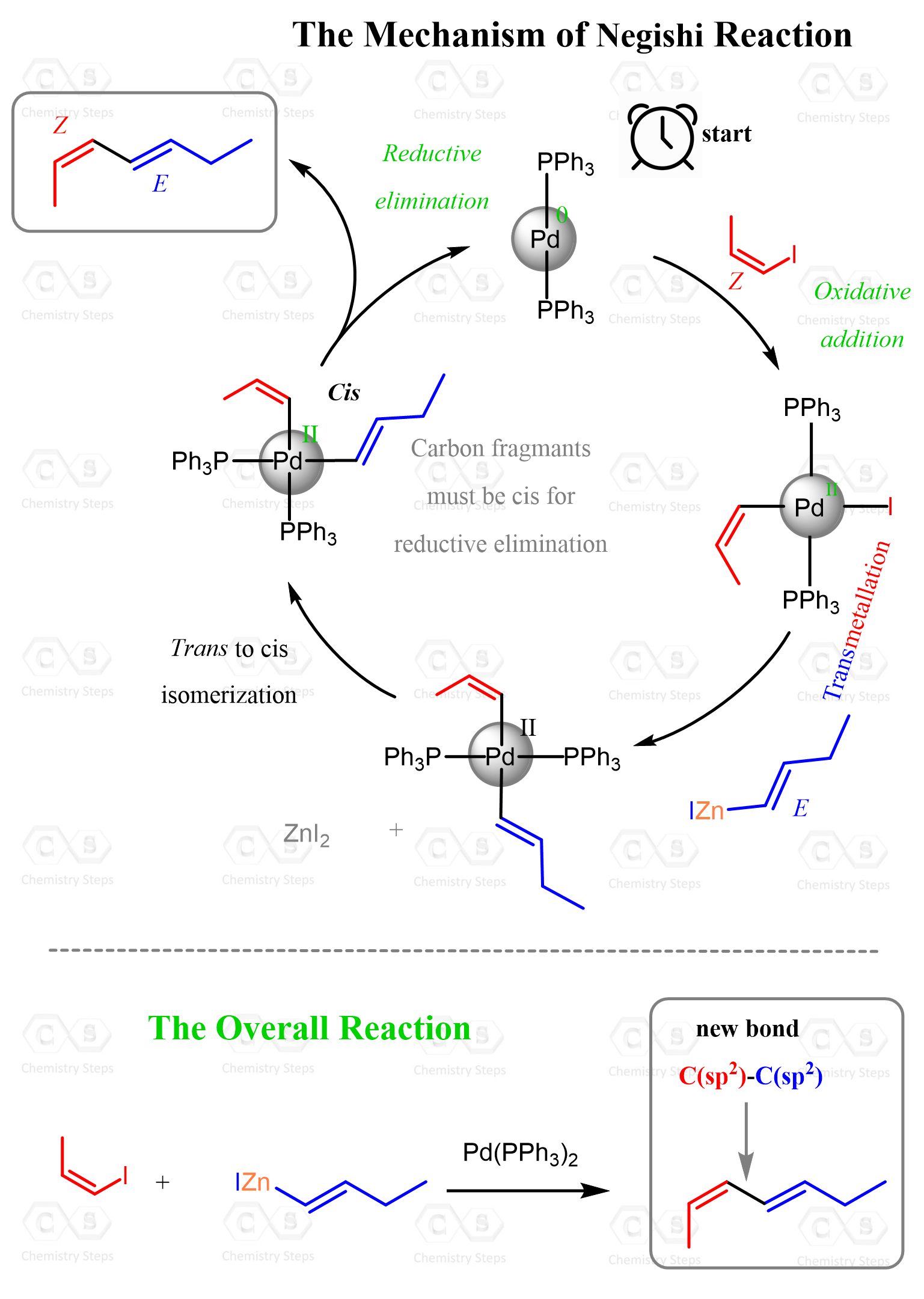
Notice how Pd(0) is converted into different palladium intermediates through oxidative addition, transmetalation, and reductive elimination, ultimately regenerating Pd(0) and allowing the process to repeat.
The Regio- and Stereoselectivity of the Negishi Coupling Reaction
Negishi reaction is generally regioselective, meaning that the position of the new C–C bond is determined by the location of the halide or triflate leaving group and the C-Zn bond. In other words, the coupling occurs specifically between the carbon bearing the halide/triflate on one coupling partner and the carbon attached to tin in the organotin reagent:
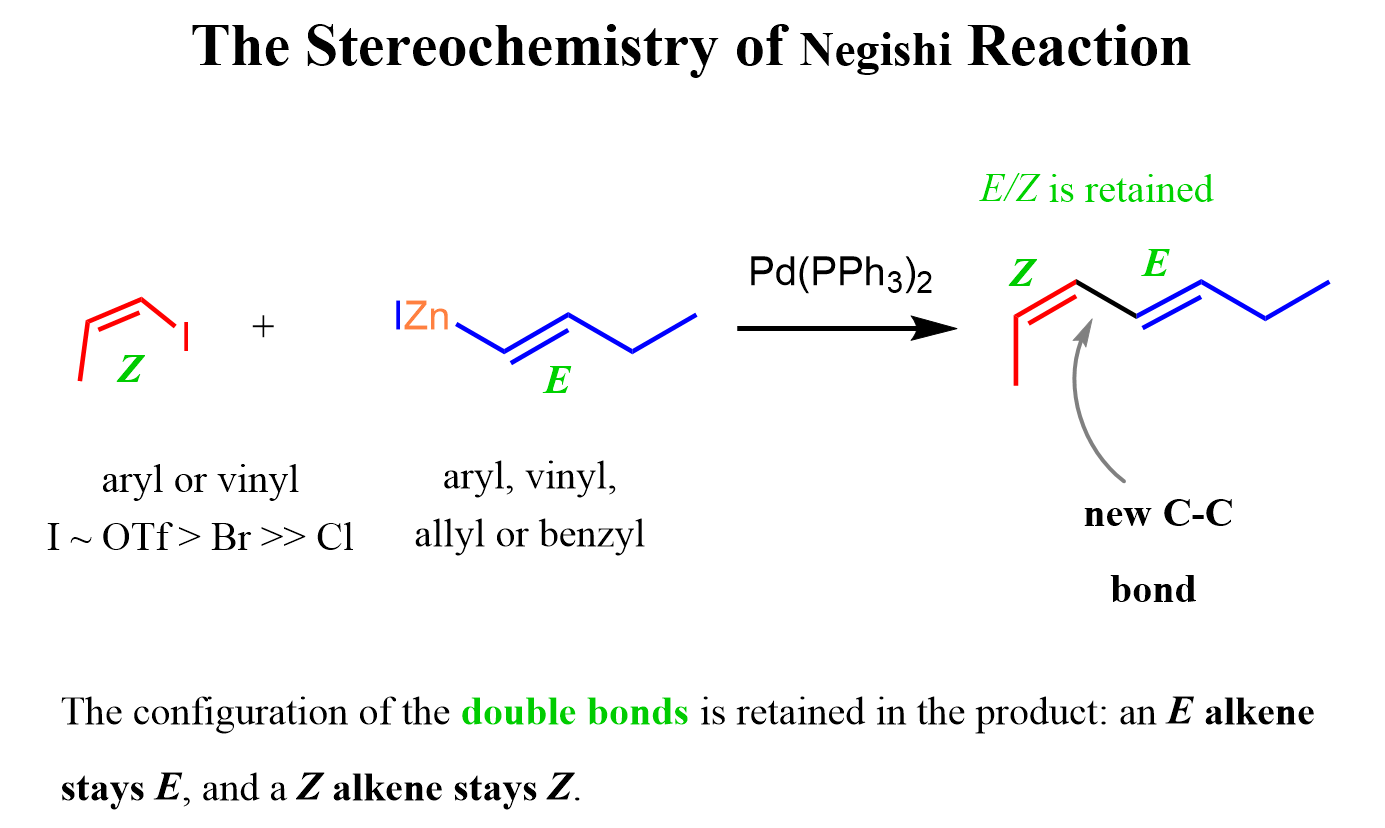
Notice also that the Negishi reaction is also stereospecific, which means that the configurations of the reacting double bonds are preserved during the coupling process. Therefore, the E and Z configurations of both the organic halide and the organotin reagent are retained in the resulting coupled alkene product because the oxidative addition and transmetalation steps occur without disrupting the geometry of the C=C bonds.
The Advantages of Negishi Coupling
🟢 The main advantage of the Negishi reaction is the wide variety of organozinc reagents and organic electrophiles that can be used. Depending on the coupling partners, the reaction can be used to form new C(sp2)-C(sp2), C(sp2)-C(sp), and C(sp2)-C(sp3) bonds.
🟢 In addition to organozinc (Zn) reagents, organoaluminum (Al) and organozirconium (Zr) compounds have also been successfully employed in Negishi-type couplings, while nickel (Ni) and palladium (Pd) complexes are commonly used as transition-metal catalysts, further expanding the scope of the reaction.
🟢 Another important advantage of the Negishi coupling is its high regio- and stereoselectivity. In particular, coupling reactions involving alkenyl halides and alkenyl organozinc reagents often proceed with excellent retention of alkene configuration, allowing the selective formation of E or Z products.
🔴 With all the advantages the Negishi coupling offers, its main limitation is perhaps the relatively high reactivity of organozinc reagents. The C-Zn bond is considerably more polarized than, for example, the C-Sn bond used in the Stille reaction. As a result, the carbon atom bonded to zinc has greater carbanion character, making organozinc reagents much more reactive. While this high reactivity often leads to faster transmetalation and efficient cross-coupling, it also makes many organozinc compounds air- and moisture-sensitive, requiring dry solvents, an inert atmosphere, and careful handling. This is in contrast to organostannanes, used in Stille coupling, which are generally much more stable and easier to store and handle.
In the next few posts, we will discuss the Heck, Stille, Suzuki, and Sonogashira reactions, which provide alternative approaches for C–C bond formation and address some of the limitations of the Negishi coupling, such as the air and moisture sensitivity of organozinc reagents.
Reference
- Negishi, E.; King, A. O.; Okukado, N. Selective Carbon–Carbon Bond Formation via Transition Metal Catalysis. Org. Chem. 1977, 42, 1821–1823.
- Negishi, E.-i.; Hu, Q.; Huang, Z.; Qian, M.; Wang, G. Recent Advances in the Negishi Coupling Reaction. Aldrichimica Acta 2005, 38, 71–87.
- Phapale, V. B.; Cárdenas, D. J. Nickel-Catalysed Negishi Cross-Coupling Reactions: Scope and Mechanisms. Soc. Rev. 2009, 38, 1598–1607.
- Haas, D.; Hammann, J. M.; Greiner, R.; Knochel, P. Recent Developments in Negishi Cross-Coupling Reactions. ACS Catal. 2016, 6, 1540–1552.
- Kambe, N.; Iwasaki, T.; Terao, J. Pd-Catalyzed Cross-Coupling Reactions of Alkyl Halides and Organometallic Reagents. Soc. Rev. 2011, 40, 4937–4947.
- Clayden, J.; Greeves, N.; Warren, S. Organic Chemistry, 2nd ed.; Oxford University Press: Oxford, 2012.
- László Kürti and Barbara Czakó, Strategic Applications of Named Reactions in Organic Synthesis, 2005
Check Also
- Pd-Catalyzed Cross-Coupling Reactions
- Heck Reaction
- Suzuki Reaction
- Stille Coupling
- Sonogashira Coupling
- Alkene Metathesis