
Before giving the official definition of pericyclic reactions, let’s recall that so far, the most common reaction we have seen in organic chemistry class in which a cyclic structure is formed is the Diels-Alder reaction. In the vast majority of the Diels-Alder reactions you saw, a cyclohexene ring is the skeletal structure of the product:

So, what else do we know about the Diels-Alder reaction aside from the fact that it forms a cyclic product?
The second important characteristic of this reaction is that it follows a concerted mechanism, meaning that all the bonds involved in the reaction are broken and formed simultaneously, in a single step.
As a quick reference, recall some reactions where the breaking and formation of bonds were not simultaneous. For example, this is what we have in unimolecular reactions such as E1 and SN1, as well as most of the addition reactions to alkenes, alkynes, and aromatic compounds via electrophilic addition or electrophilic aromatic substitution mechanisms. These are stepwise mechanisms:

Alright, so the Diels-Alder reaction is a concerted reaction where a cyclic product is formed. This should also tell us that the transition state of the Diels-Alder reaction has a cyclic arrangement of the interacting atoms and orbitals. For example, the following Diels-Alder reaction between cyclopentadiene and cyclohexenone gives endo and exo products, which we can visualize through their corresponding transition states:
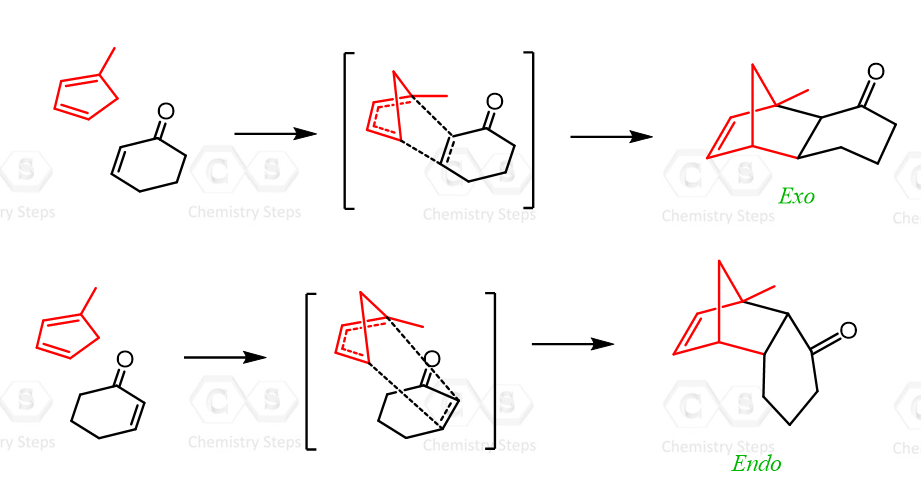
It turns out that the Diels-Alder reaction is not the only reaction that proceeds through a concerted mechanism via a cyclic transition state.
For example, the following reaction represents the conversion of an open-chain triene into cis-5,6-dimethylcyclohexa-1,3-diene, and it turns out that it also follows a concerted mechanism:
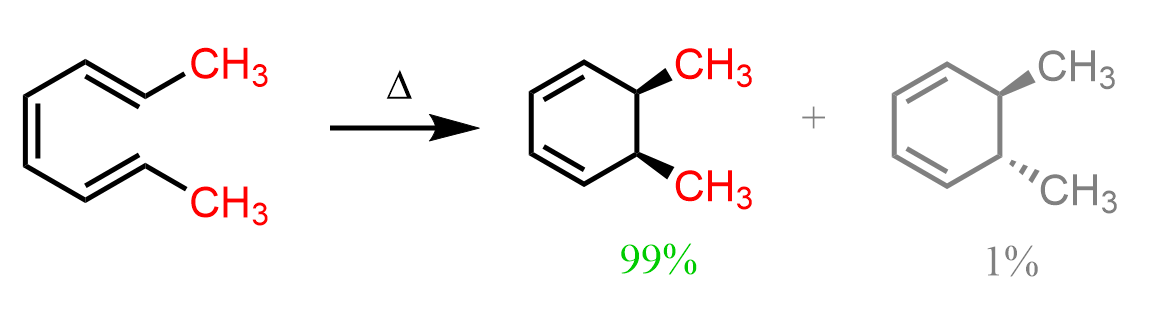
All the bonds involved in the reaction are broken and formed simultaneously. It also forms a cyclic product, and therefore, the transition state has a cyclic arrangement as well:
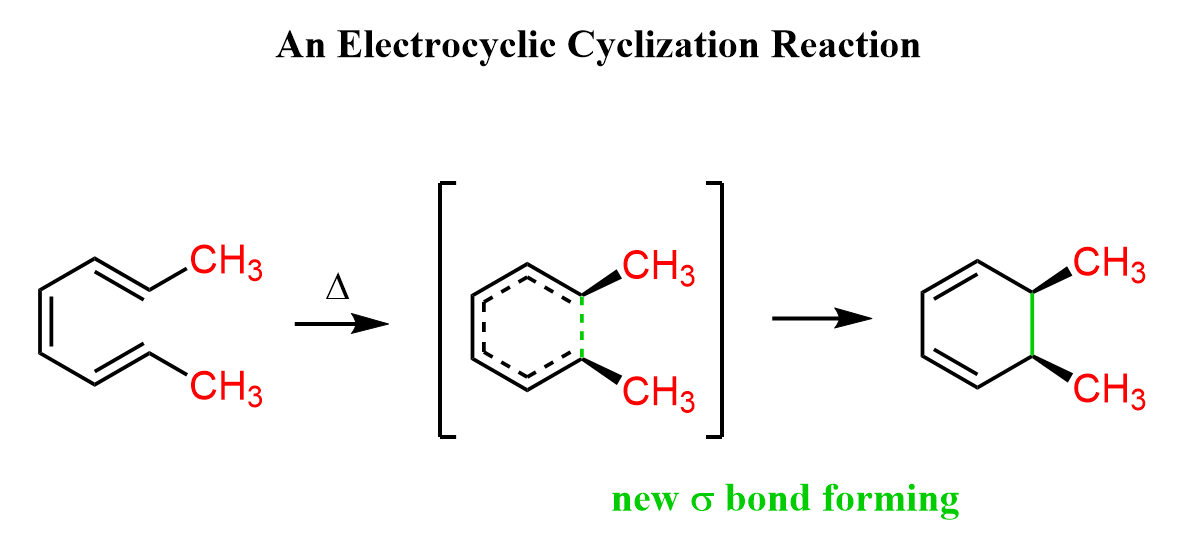
Since we mentioned the formation of cyclic products, let’s emphasize here that not only does the formation of a cyclic structure fall into this same category of reactions, but also the reverse process, where a cyclic structure is converted into an open-chain product through a concerted mechanism.
For example, trans-3,4-dimethylcyclobutene contains a strained four-membered ring. Therefore, upon heating, it can undergo a ring-opening reaction through a concerted electrocyclic mechanism, relieving the ring strain and forming the more stable conjugated diene, (2E,4E)-2,4-hexadiene:
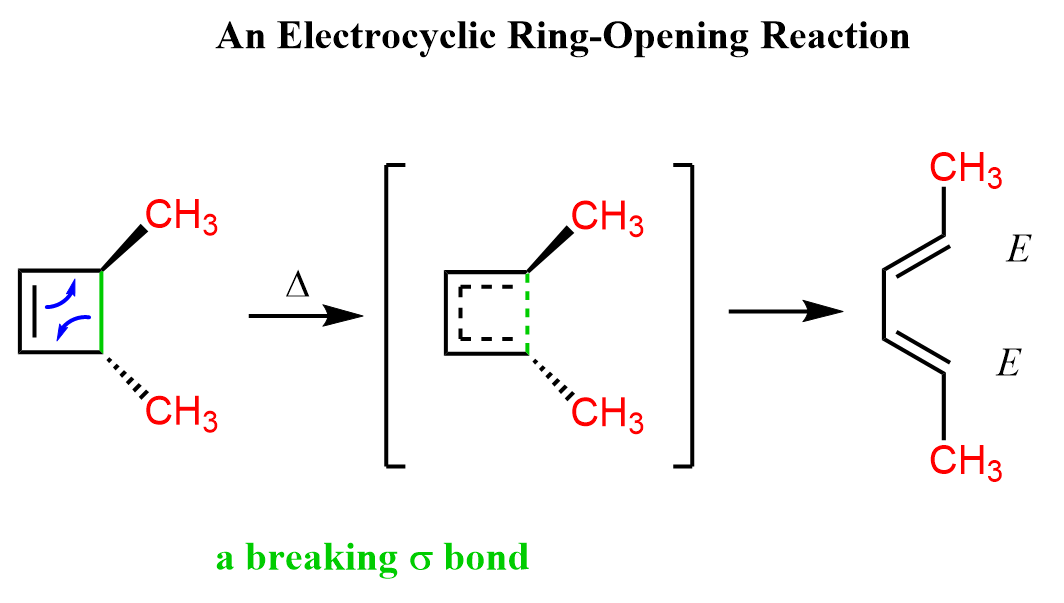
These two reactions represent electrocyclic reactions, a type of pericyclic reaction in which a conjugated π system undergoes ring closure or ring opening through the formation or breaking of a σ bond. In other words, the reaction converts an open-chain conjugated system into a cyclic structure, or vice versa, through a concerted mechanism.
All of what we have talked about so far falls into the broader category of reactions known as pericyclic reactions.
A pericyclic reaction is a reaction that takes place through a concerted reorganization of electrons in a cyclic transition state.
Of course, the Diels-Alder reaction and the intramolecular conversion of the open-chain triene have some similarities and differences. We mentioned the similarities, but notice also that, if nothing else, one is an intermolecular reaction while the other is intramolecular.
Therefore, pericyclic reactions can be divided into several main types, including electrocyclic reactions, cycloadditions, and sigmatropic rearrangements:
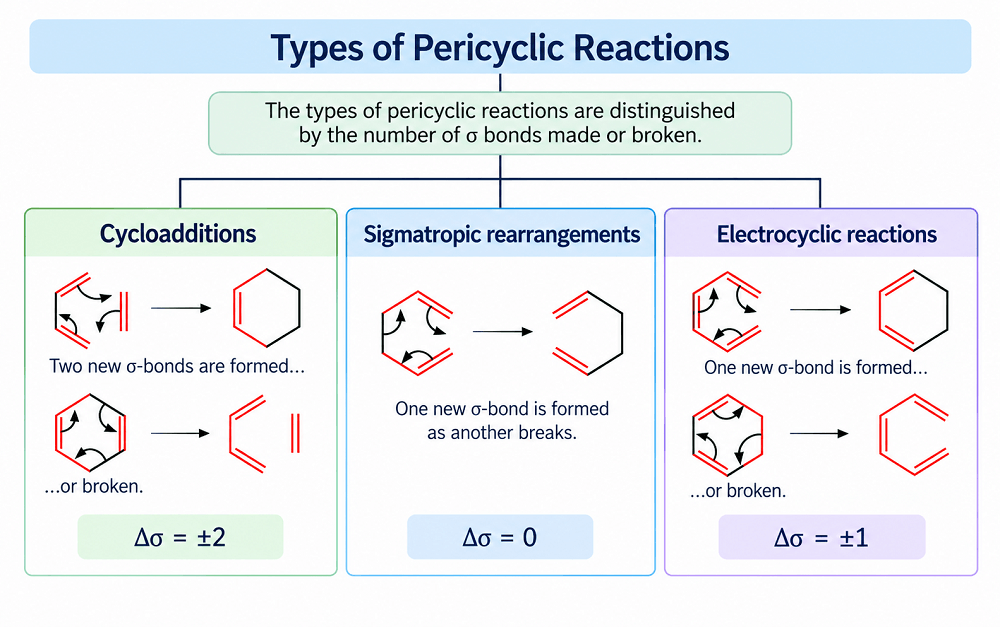
We also need to know that the Diels-Alder reaction is a type of cycloaddition reaction, and we call it a [4+2] cycloaddition because four π electrons from the conjugated diene combine with two π electrons from the dienophile to form a six-membered ring.
There are other types of cycloaddition reactions as well, such as [2+2] cycloadditions and [3+2] cycloadditions.
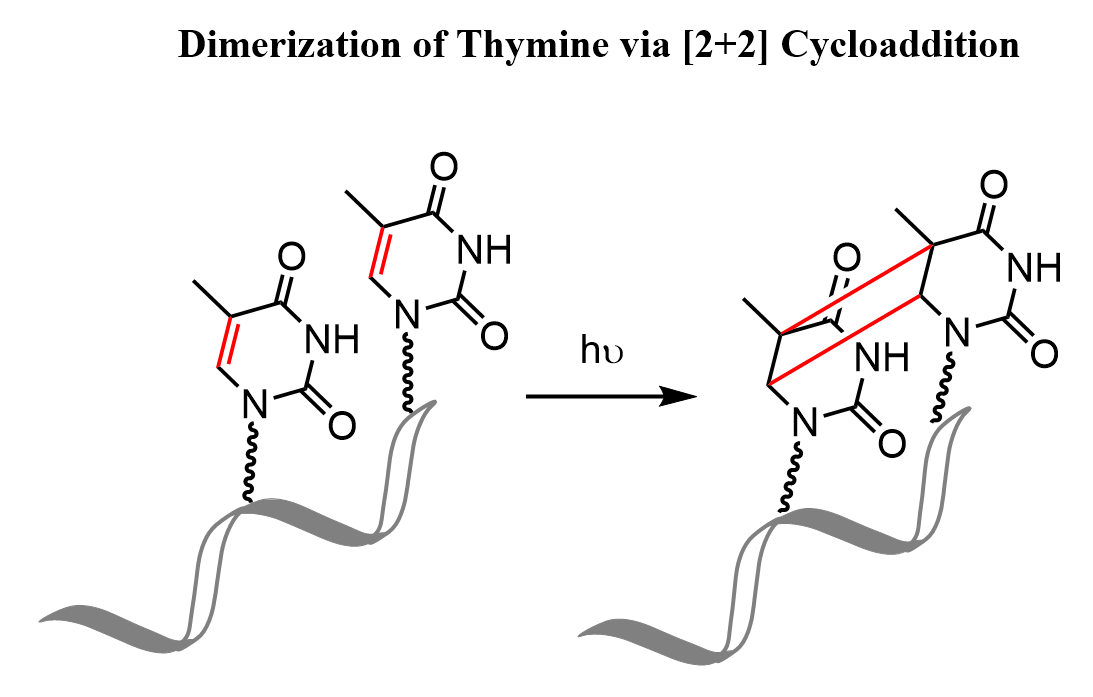
A particularly interesting example is the photochemical dimerization of thymine, one of the pyrimidine bases found in DNA. When two adjacent thymine bases absorb UV light, their C5=C6 double bonds can undergo a [2+2] cycloaddition, forming a four-membered cyclobutane ring that connects the two thymine units:
Sigmatropic Rearmaments
The last type of pericyclic reactions you need to know are sigmatropic rearrangements. These are concerted reactions in which a σ bond is broken, and a new σ bond is formed at a different position within a molecule, accompanied by a reorganization of the π bonds.
In other words, a σ bond essentially migrates from one position to another, while the π-electron system shifts accordingly.
We classify these reactions using numbers such as [1,5] or [3,3], which indicate the positions between which the σ bond migrates and the number of atoms involved in the rearrangement.
For example, in the following rearrangement, the allyl group migrates from the oxygen atom to the ortho position of the aromatic ring:
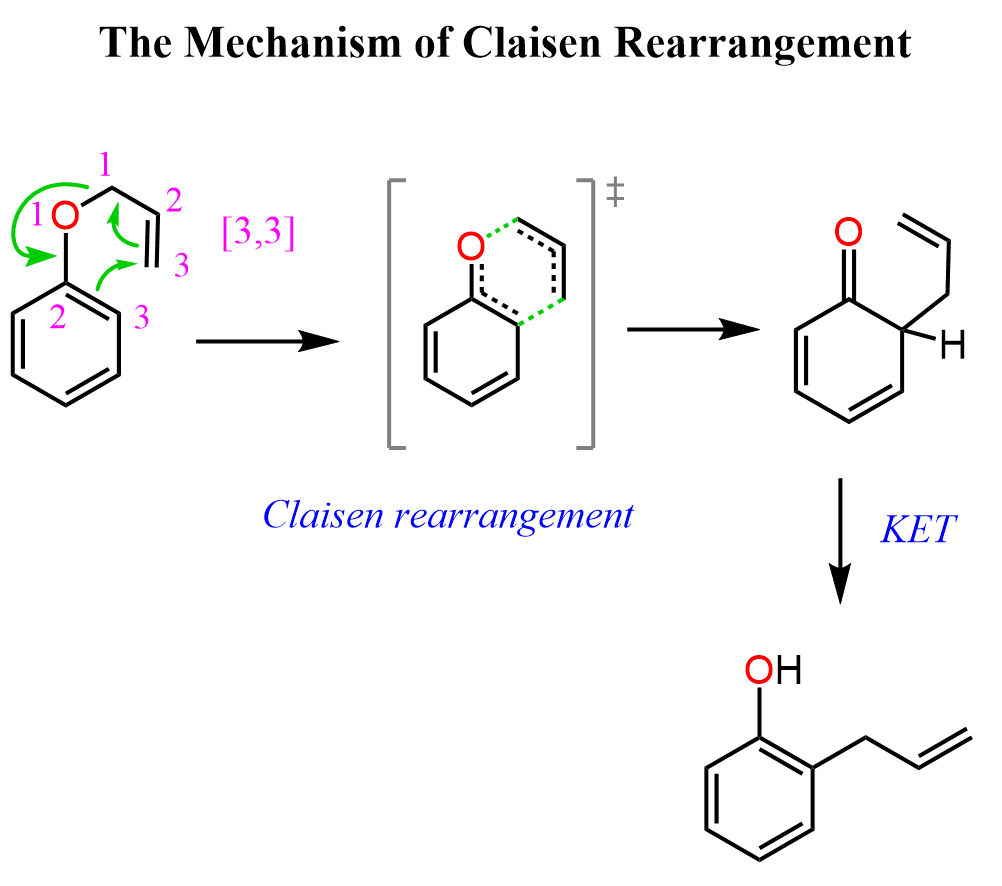
This is an example of a Claisen rearrangement, a [3,3]-sigmatropic rearrangement. Notice that the reaction proceeds through a concerted mechanism involving a cyclic transition state, where the C–O bond breaks, a new C–C bond forms, and the π bonds reorganize simultaneously.
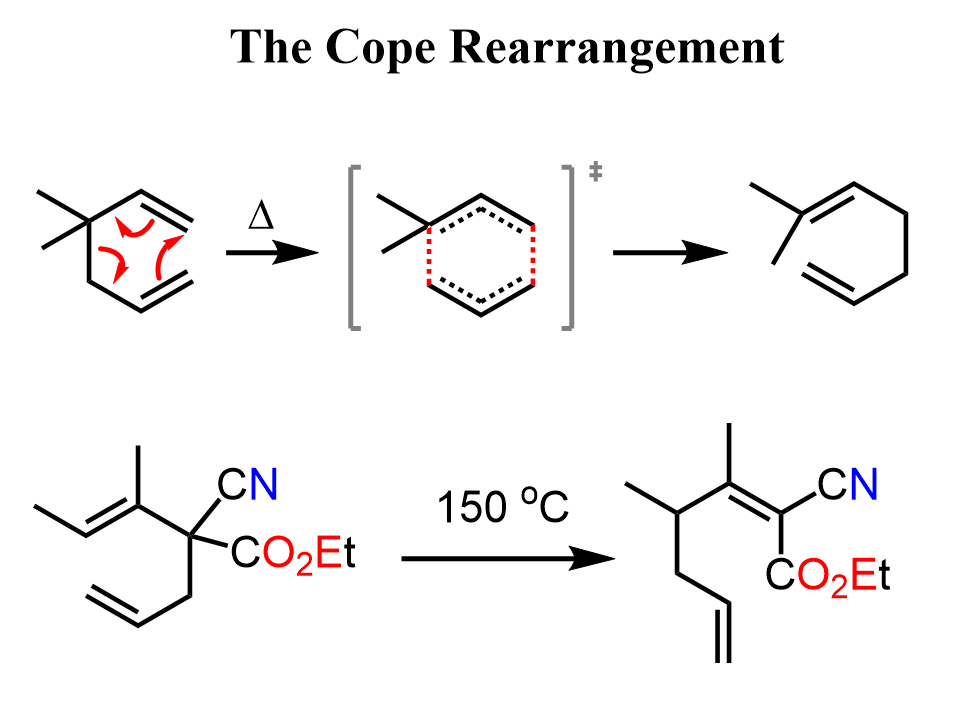
A similar rearrangement happens with 1,5-dienes, known as the Cope rearrangement. Like the Claisen rearrangement, it is a concerted pericyclic process that proceeds through a six-membered cyclic transition state, where bonds are broken and formed simultaneously in a single step with no intermediates. In both cases, a σ bond migrates across a π system in a stereospecific fashion, following orbital symmetry rules. The key similarity is that both are [3,3]-sigmatropic rearrangements involving 6 π-electrons in a cyclic transition state:
In the following series of articles, we will discuss the stereochemistry of the aforementioned reactions, including the Diels-Alder reaction and other cycloaddition reactions, Claisen and Cope rearrangements, and electrocyclic reactions.
We will pay special attention to the molecular orbitals involved in these reactions, as their symmetry is the key factor in understanding how these reactions occur.
In particular, we will see why the endo product is normally considered the major product in the Diels-Alder reaction, what suprafacial and antarafacial interactions are, how molecular orbital symmetry determines the direction of bond rotation in electrocyclic reactions and, consequently, the stereochemistry of their products.
We will also explore the effects of HOMO-LUMO interactions, including their efficiency and orbital coefficients, in explaining many interesting aspects of organic reactions, particularly pericyclic reactions.
Last but not least, we will also address the question of why the [2+2] photochemical dimerization of thymine is, luckily, not as facile as its [4+2] Diels-Alder counterpart.
That may seem like quite a lot to cover, but, as always, we’ll stick to the main goal of this site: breaking down complex chemistry concepts into simple, approachable explanations that are easy to understand.
Molecular Orbitals and Organic Reactions
- Molecular Orbitals Made Easy
- The Molecular Orbital Theory of Organic Molecules
- The Molecular Orbital of Acetylene
- The Molecular Orbitals of Carbonyls
- Orbital Coefficients, HOMO-LUMO Interactions, and Reactivity
- Hard and Soft Acids and Bases
- Molecular Orbitals and UV-Vis Spectroscopy
- Molecular Orbitals of 1,3-Butadiene
- 1,3,5-Hexatriene Pi Molecular Orbitals
- The Molecular Orbitals of Allylic Systems
- The Molecular Orbitals of Benzene
- Molecular Orbitals in Diels-Alder and Other Cycloaddition Reactions
- Diels-Alder Reactions: EWG, EDG, and MO Interactions
- Electrocyclic Reactions
- Sigmatropic Hydrogen Shifts
- Pericyclic Reactions Practice Problems