
The Simmons-Smith reaction converts alkenes into cyclopropanes by adding a CH2 (methylene) group across the C=C double bond:
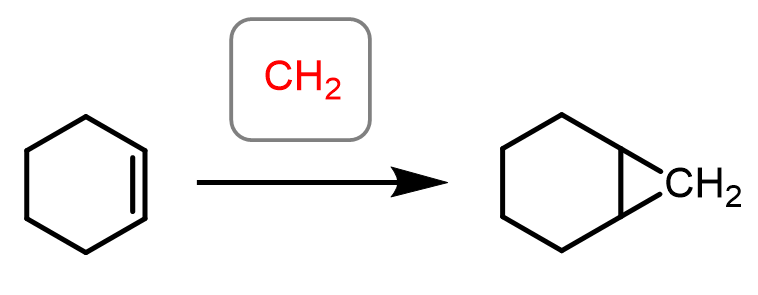
Of course, this is easier said than done because we don’t have a bottle of CH2 sitting in the lab. The question, then, is how we can accomplish this transformation.
The answer was provided by Howard E. Simmons and Ronald D. Smith in 1958, when they reported a new method for synthesizing cyclopropanes directly from alkenes. Their method involved reacting an alkene with diiodomethane (CH2I2) in the presence of a zinc-copper couple (Zn(Cu)):
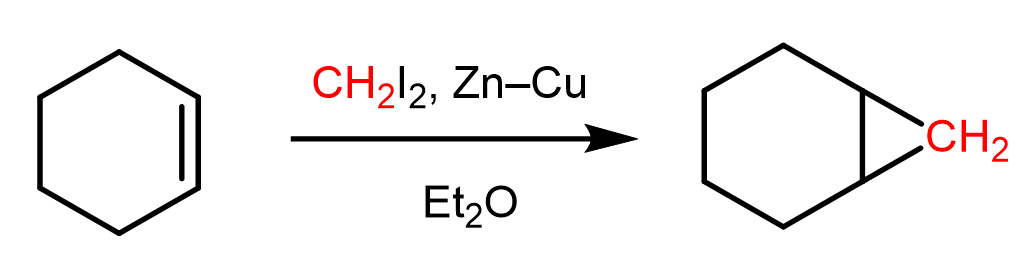
This combination generates a reactive organozinc species that transfers the CH₂ group to the double bond, producing a cyclopropane.
The Mechanism of the Simmons-Smith Reaction
The first step involves the conversion of diiodomethane into ICH2ZnI, an organozinc reagent. Although the actual organozinc species involved can be more complex, iodomethylzinc iodide is commonly considered the main reactive species in the Simmons-Smith reaction. Therefore, the organozinc reagent is commonly represented as iodomethylzinc iodide (ICH2ZnI):
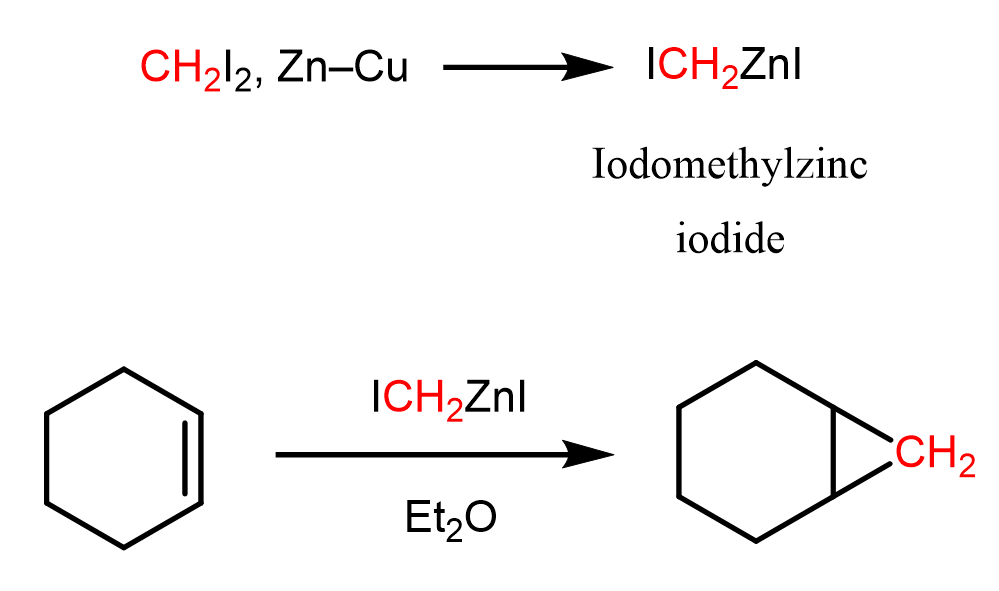
Organozinc reagents are much like Grignard reagents, if you are familiar with them. Both contain a carbon-metal bond, which is highly polarized because carbon is more electronegative than the metal. Although organozinc reagents are less polarized than Grignard reagents, you can look at them as sources of carbanions or at least highly nucleophilic carbon sources.
However, the reaction does not proceed through a simple nucleophilic attack of the C–Zn bond on the alkene. Instead, the methylene group is transferred to the alkene in a concerted process where, as the C=C π bond is broken, two new C–C σ bonds form between the methylene carbon and the two alkene carbons:
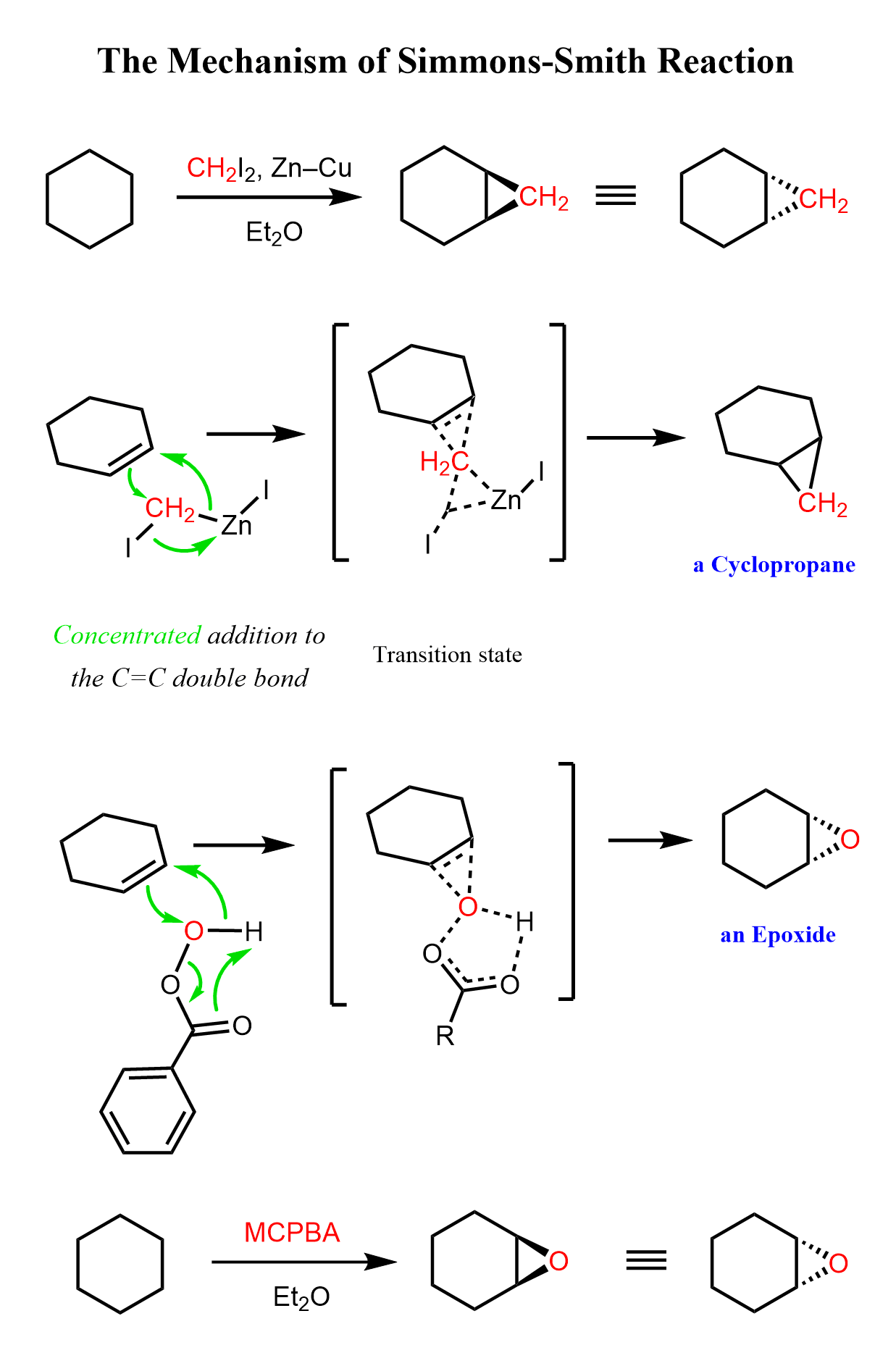
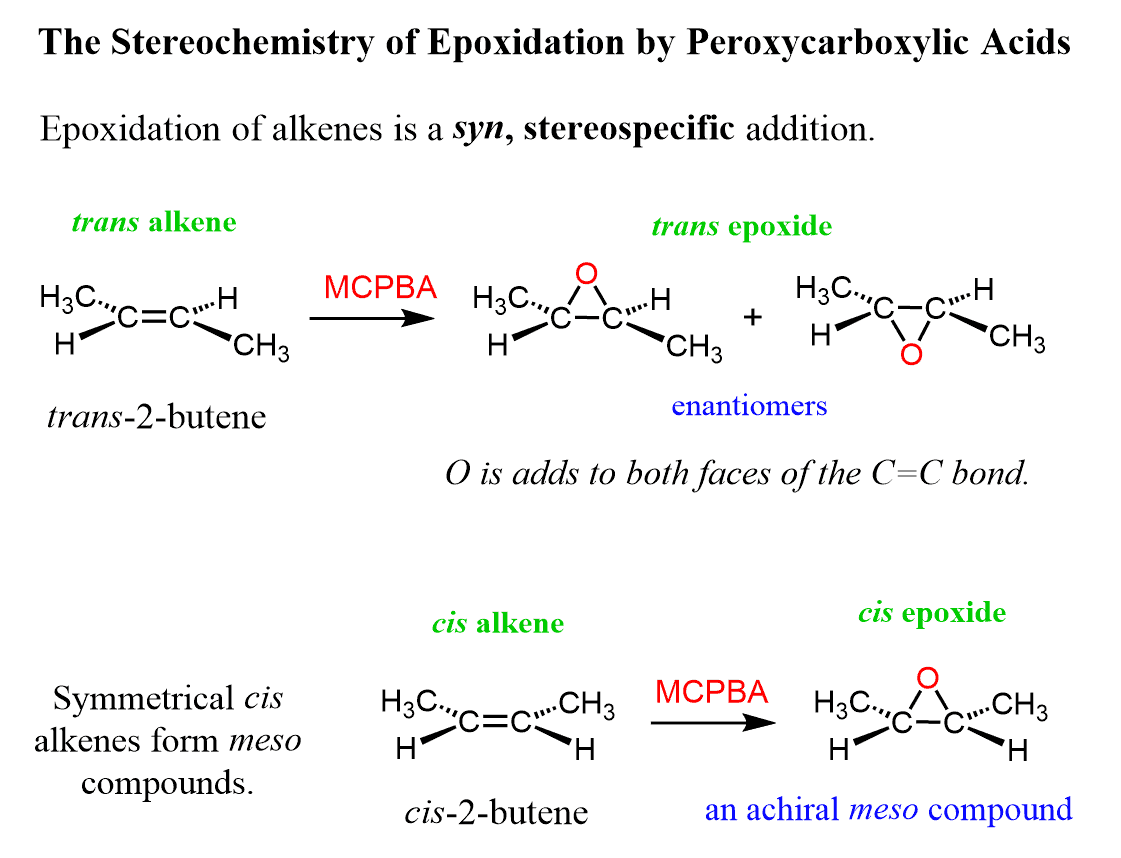
You may recall a somewhat similar process from the epoxidation of alkenes using peroxyacids such as mCPBA. In that reaction, an oxygen atom is transferred from the peroxyacid to the alkene, converting the C=C double bond into an epoxide ring. The two new C–O bonds form in a concerted process through a cyclic transition state, without the formation of a discrete carbocation intermediate.
The Stereochemistry of the Simmons-Smith Reaction
One important consequence of this concerted mechanism is that the reaction is stereospecific. The original geometry of the alkene is retained during cyclopropane formation. Thus, the relative stereochemistry of the alkene is preserved during cyclopropanation: cis alkenes produce cis cyclopropanes, whereas trans alkenes produce trans cyclopropanes.
Here are some examples of the Simmons-Smith reaction where we can see its stereospecific nature, as well as the formation of different stereoisomeric products depending on the structure of the alkene:
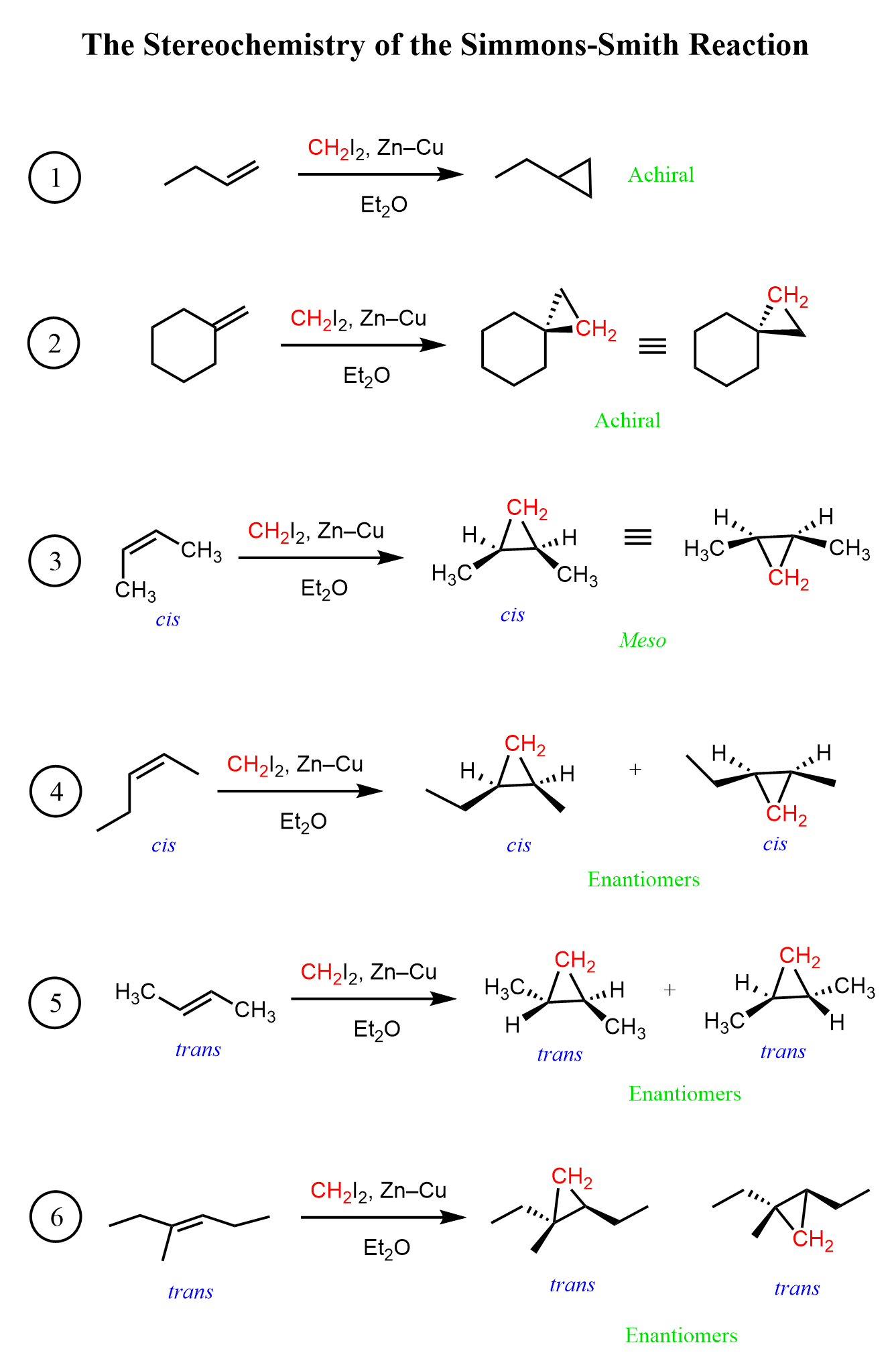
In the first two reactions, the alkenes are nonstereoisomeric because they have two identical groups at least on one end of the double bond, and in these cases, the cyclopropanes are achiral.
Reactions 3 and 4 represent the Simmons-Smith reaction of alkenes with cis (Z to be more inclusive), and notice that the cyclopropane is also cis. Notice also that when the cis alkene is symmetric, the product is a meso compound (reaction 3). On the other hand, the cis cyclopropanes in reaction 4 are a pair of enantiomers, as, unlike the previous reaction, they lack a plane of symmetry.
Once again, this is what we have also seen in the epoxidation of alkenes:
The trans alkenes in reactions 5 and 6 form a pair of enantiomers.
Carbenes in Cyclopropanation Reactions
In all the Simmons-Smith reactions, iodomethylzinc iodide (ICH2ZnI) serves as a source of CH2, and if you did not know, it turns out that CH2 and similar species do exist, and they are called carbenes. Although we encounter them a lot less, they are just another type of carbon species, like carbocations, carbanions, carbon radicals, etc.:
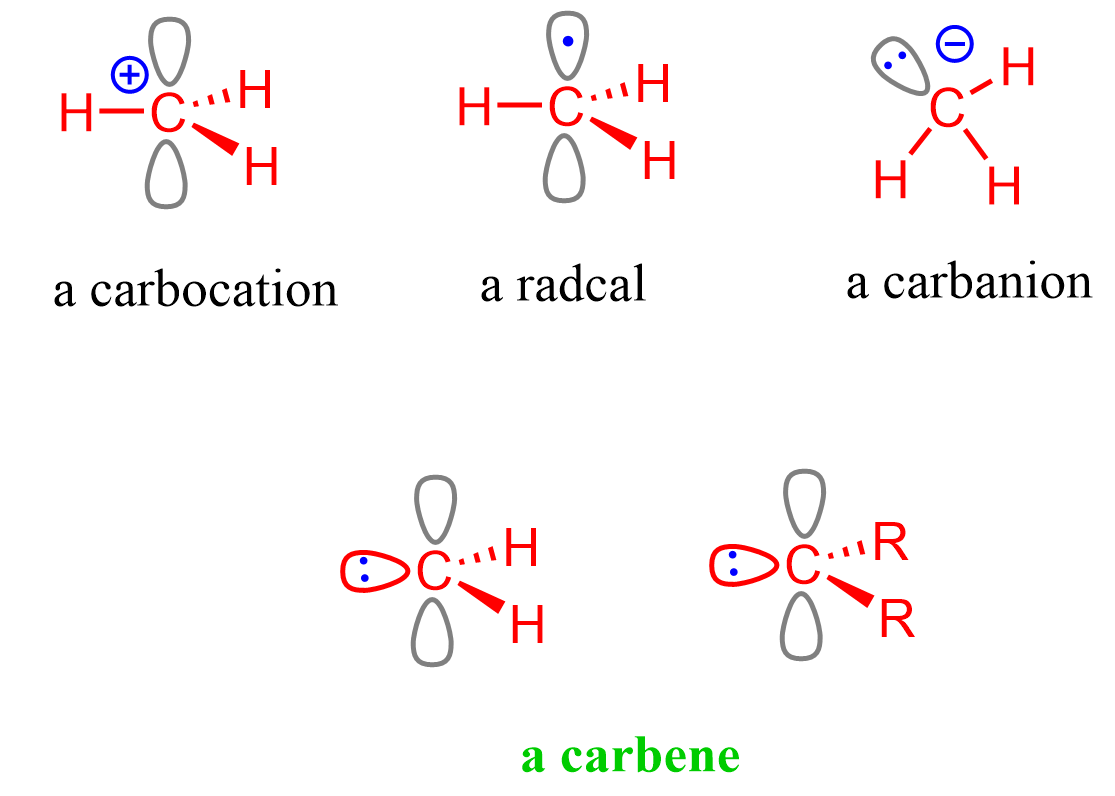
Carbenes are neutral, highly reactive carbon species containing a divalent carbon atom with only six valence electrons. They are generally unstable and short-lived, although their stability varies considerably depending on their structure and substituents. In any case, as we mentioned at the beginning of the post, we don’t have a bottle of carbene sitting in the lab. They are formed and reacted in situ, meaning they are generated in the reaction mixture and consumed in subsequent reactions rather than isolated.
A typical example of preparing a carbene is the reaction of chloroform (CHCl3) with a strong base. The first step is a deprotonation, forming a trichloromethyl carbanion, which then loses one of the chlorine atoms in the form of a chloride ion to get rid of the negative charge. This leaves the carbon atom with a formal charge of zero, but what is unusual is the presence of an empty orbital:
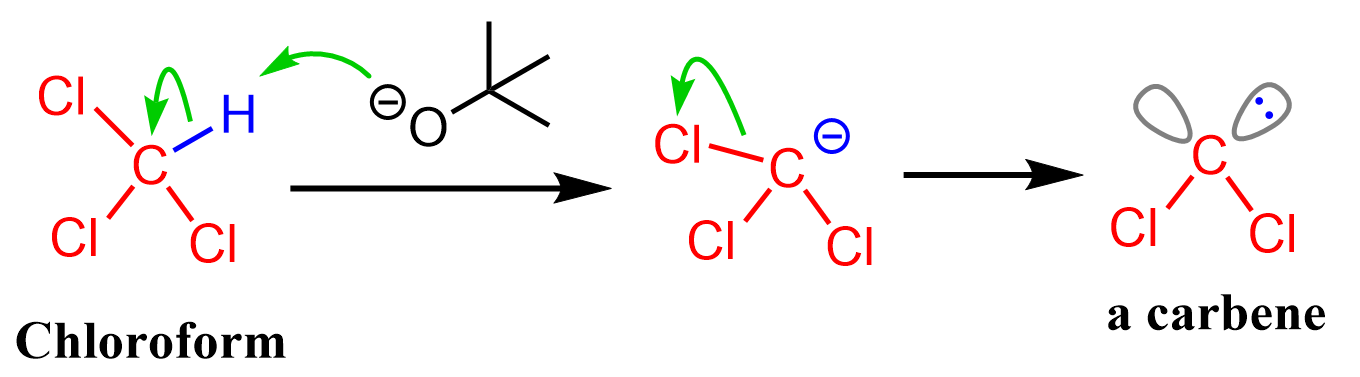
So, on one hand, a carbene has a lone pair and can act as a nucleophile, while on the other hand, it also has an empty orbital, which enables it to serve as an electrophile:
This is essentially what makes the addition to the alkene π bond possible. We know that alkenes are electron-rich species due to their π bond, and therefore, they can act as a nucleophile and attack the carbene. At the same time, the lone pair on the carbene serves as a nucleophile to form the second C–C bond of the cyclopropane:
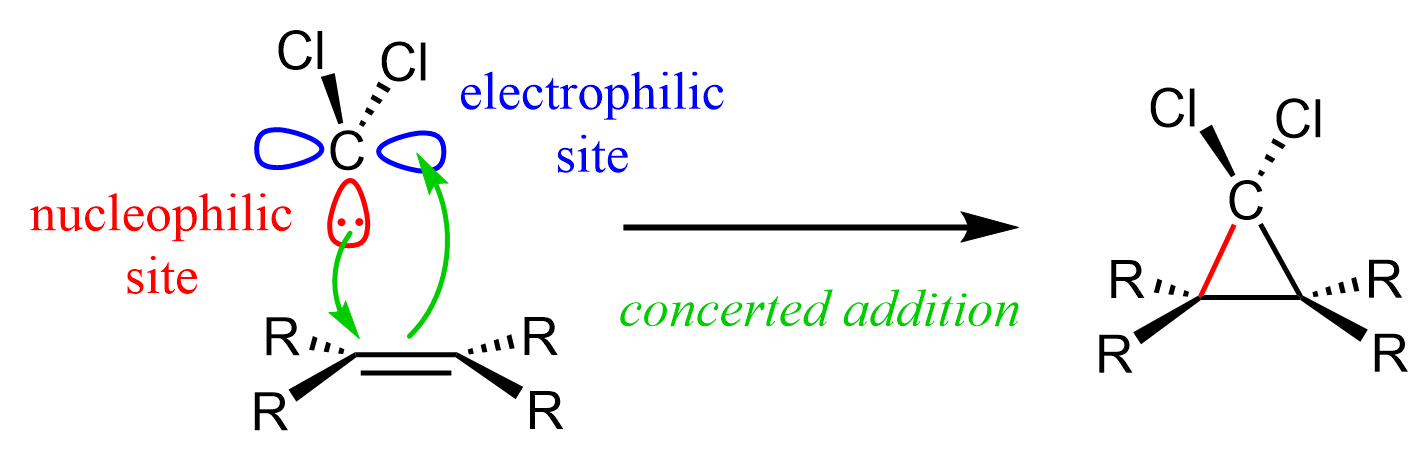
Although the carbene example above produces dichlorocarbene (:CCl2), not methylene (:CH2), iodomethylzinc iodide is often called a carbenoid because it acts as a methylene-transfer reagent in the Simmons-Smith reaction.
Carbenes are unique in their structure and reactivity, and their chemistry is an entire topic in organic chemistry in its own right. To keep this post focused on the Simmons-Smith reaction, we will discuss the structure and reactions of carbenes in the next article.
Check Also
- Electrophilic Addition Reactions to Alkenes
- Markovnikov’s Rule
- Markovnikov’s Rule with Practice Problems
- Addition of Water to Alkenes
- Acid-Catalyzed Hydration of Alkenes with Practice Problems
- Rearrangements in Alkene Addition Reactions
- Oxymercuration-Demercuration
- Addition of Alcohols to Alkenes
- Free-Radical Addition of HBr: Anti-Markovnikov Addition
- Hydroboration-Oxidation: The Mechanism
- Hydroboration-Oxidation of Alkenes: Regiochemistry and Stereochemistry with Practice Problems
- Halogenation of Alkenes and Halohydrin Formation
- The Regiochemistry of Alkene Addition Reactions
- The Stereochemistry of Alkene Addition Reactions
- Cis product in an anti-Addition Reaction of Alkenes
- Ozonolysis of Alkenes with Practice Problems
- Syn Dihydroxylation of Alkenes with KMnO4 and OsO4
- Anti-Dihydroxylation of Alkenes with MCPBA and Other Peroxides with Practice Problems
- Catalytic Hydrogenation
- Oxidative Cleavage of Alkenes with KMnO₄ and O₃
- Alkene Reactions Practice Problems
- Changing the Position of a Double Bond
- Changing the Position of a Leaving Group
- Alkenes Multi-Step Synthesis Practice Problems
- Reactions of Norbornane Derivatives
- Alkene Addition Reactions Practice Quiz
- Reactions Map of Alkenes