
Alkanes are the first class of organic compounds we learn when starting organic chemistry. They are also the simplest organic molecules because they are only composed of carbon and hydrogen atoms that are connected with single bonds only.
Here are some examples of alkanes, and what you want to pay attention to is the fact that all the carbons have four bonds – remember, carbon can never have more than four bonds. As mentioned earlier, there are also no double or triple bonds in alkanes:
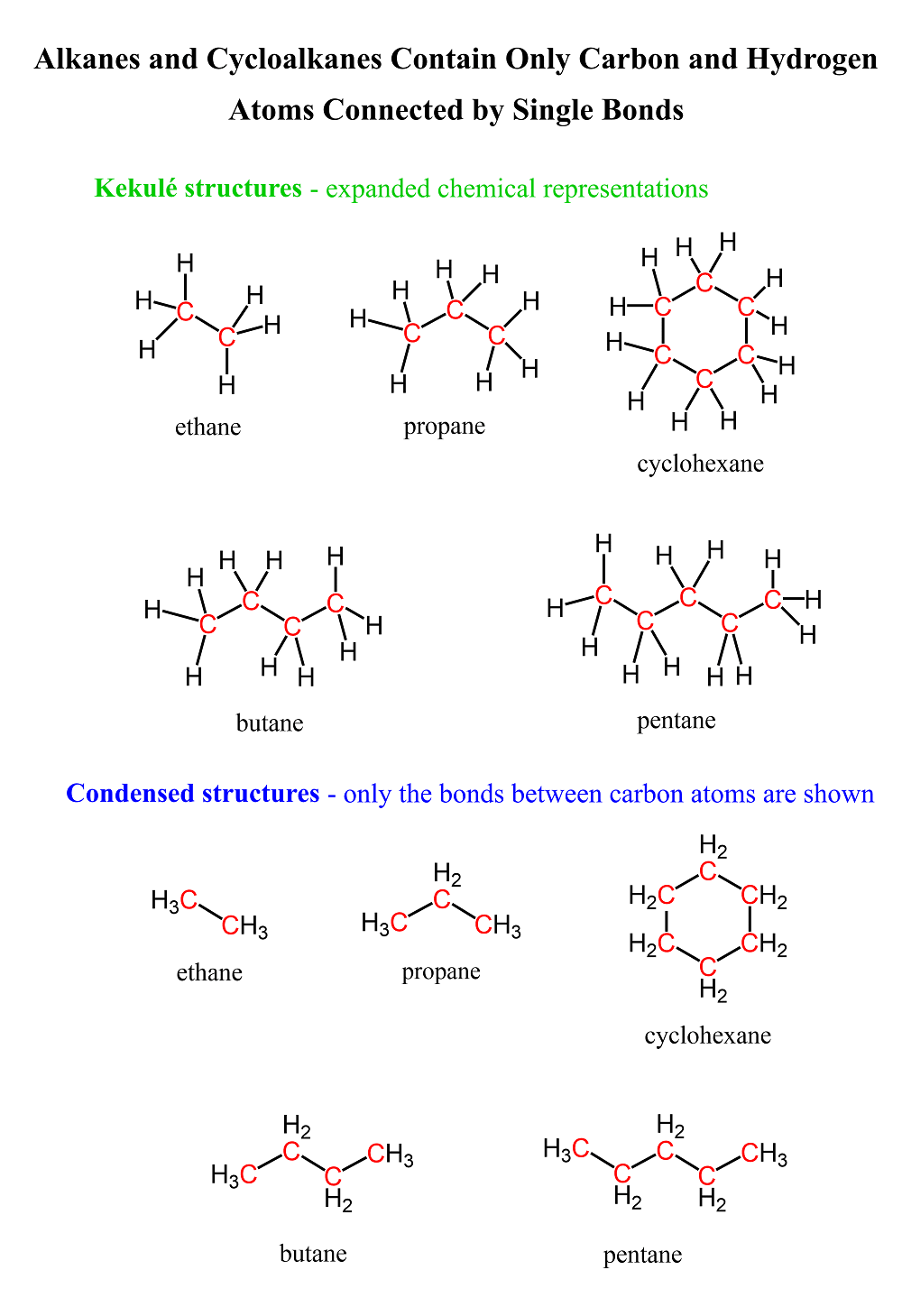
The alkanes above are shown using both Kekulé and condensed structures. The former shows every atom and bond in the molecule, while the latter groups each carbon atom with its attached hydrogen atoms, providing a more compact way of representing the structure.
The general formula of alkanes is CₙH₂ₙ₊₂, which means that for every n carbon atoms, the molecule contains (2n + 2) hydrogen atoms, corresponding to saturated hydrocarbons with only single bonds.
According to the general formula, here are the formulas and names of the first ten alkanes, which you need to memorize as they are the basis of naming substituted alkanes, alkenes, alkynes, cycloalkanes, and essentially everything else:

The reason we call them saturated hydrocarbons is that they contain the maximum possible number of hydrogen atoms, with all carbon atoms connected by single (σ) bonds only.
There are other hydrocarbons, such as alkenes and alkynes, which are unsaturated because they contain π bonds. These π bonds reduce the number of hydrogen atoms attached to carbon. This also makes it possible for them to add hydrogen atoms through chemical reactions.
In hydrogenation reactions, the addition of hydrogen breaks the π bonds, and new single (σ) bonds are formed, converting unsaturated hydrocarbons into more saturated compounds.

We can see the unsaturation in hydrogen content in the general formulas of alkenes and alkynes as well.
- Alkanes: CnH2n+2 (saturated) – For example, C4H10, C6H14, C7H16
- Alkenes: CnH2n (1 degree of unsaturation) – For example, C4H8, C6H12, C7H14
- Alkynes: CnH2n−2 (2 degrees of unsaturation) – For example, C4H6, C6H10, C7H12
Do not worry about the alkenes and alkynes, as we will discuss their structure and reactions later in the course. Today, we are focusing on alkanes, so let’s start with their bonding, hybridization, and geometry.
The Geometry and 3D Representation of Alkanes
All the carbon atoms in alkanes are sp³-hybridized with four atoms connected to them. This means the geometry of all the carbon atoms is tetrahedral.
Here is a model of ethane that shows the tetrahedral geometry of both carbon atoms:
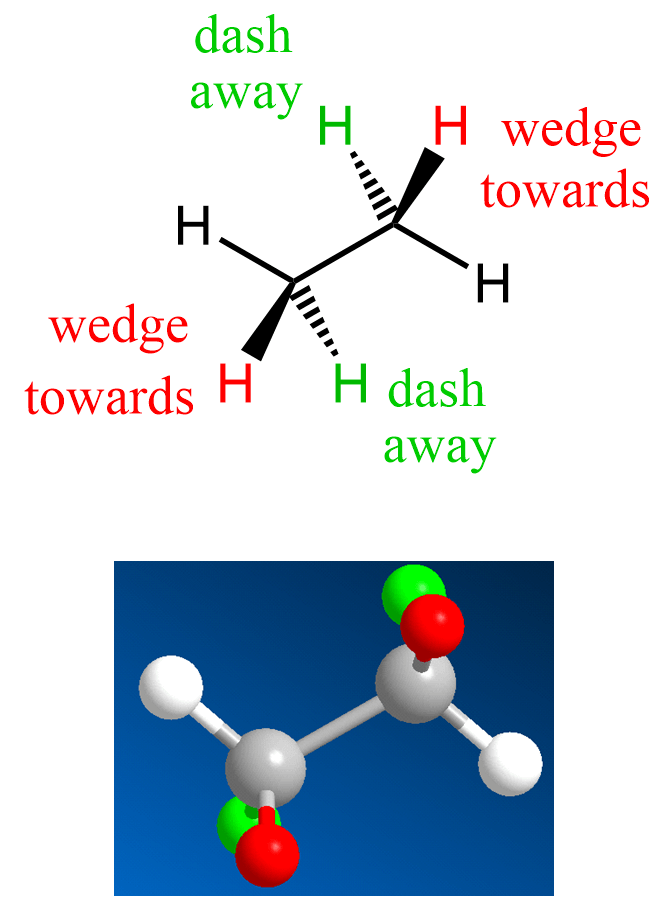
This may be the starting point of seeing molecules more in 3D representation than in simple flat drawings you used to see in general chemistry. The atoms that are shown with bold lines, also known as wedge lines, and the ones with dashed lines are to indicate if they are pointing towards you or away from.

You can read this post on the wedge and dash notation for more details and examples.
The Hybridization of Carbon Atoms in Alkanes
So, why are carbon atoms tetrahedral in alkanes?
To answer this question, let’s refresh our knowledge of hybridization theory a little bit. In simple terms, hybridization is the mixing of atomic orbitals of different types and energies to obtain new hybrid orbitals.
In the sp³ hybridization, we have one s and three p orbitals mixing, and they give four identical sp³ orbitals in shape and energy. Remember that the number of hybrid orbitals is always equal to the total number of atomic orbitals participating in the hybridization. So, three p and one s orbital give 3 + 1 = 4 sp³ hybrid orbitals:

Notice the electron jump from the 2s orbital to the empty p orbital before the hybridization of these orbitals, each having one electron, gives four sp³ orbitals with one electron in each.
The four sp3-hybridized orbitals arrange in a tetrahedral geometry, as this is the most optimal arrangement for placing the electron pairs as far away as possible (recall the VSEPR theory). The reason I said electron pairs is because each of these sp3 orbitals makes a sigma bond by overlapping with an s orbital of another atom.
Let’s see this by the example of methane (CH4), where all the hydrogens are at 109.5o and all the bonds have the same length and bond angle:

All four C – H bonds in methane are single bonds that are formed by head-on (or end-on) overlapping of the sp3 orbitals of the carbon and the s orbital of each hydrogen.
The bonds that form by the head-on overlap of orbitals are called σ (sigma) bonds because the electron density is concentrated on the axis connecting the C and H atoms.
If instead of one hydrogen, we connect another sp3-hybridized carbon, we will get ethane:

And consequently, in all the alkanes, there is a sigma bond between the carbon atoms and the carbon-hydrogen atoms, and the carbons are sp3 hybridized with tetrahedral geometry:

This should explain the bonding and geometry of alkanes, and if you need further reading on the hybridization and VSEPR theories, refer to the linked articles here.
The Bond-Line Notation of Alkanes
At some point in the class, you are going to start drawing molecules in bond-line or zig-zag notation. This is the standard approach and the “language” of organic chemistry, and the reason we do it is that, unlike General Chemistry, the molecules get pretty large here, and they consist mainly of carbon atoms, so showing so many atoms becomes impractical.
For example, here are the bond-line notations of some alkanes and cycloalkanes together with the Kekule structures:
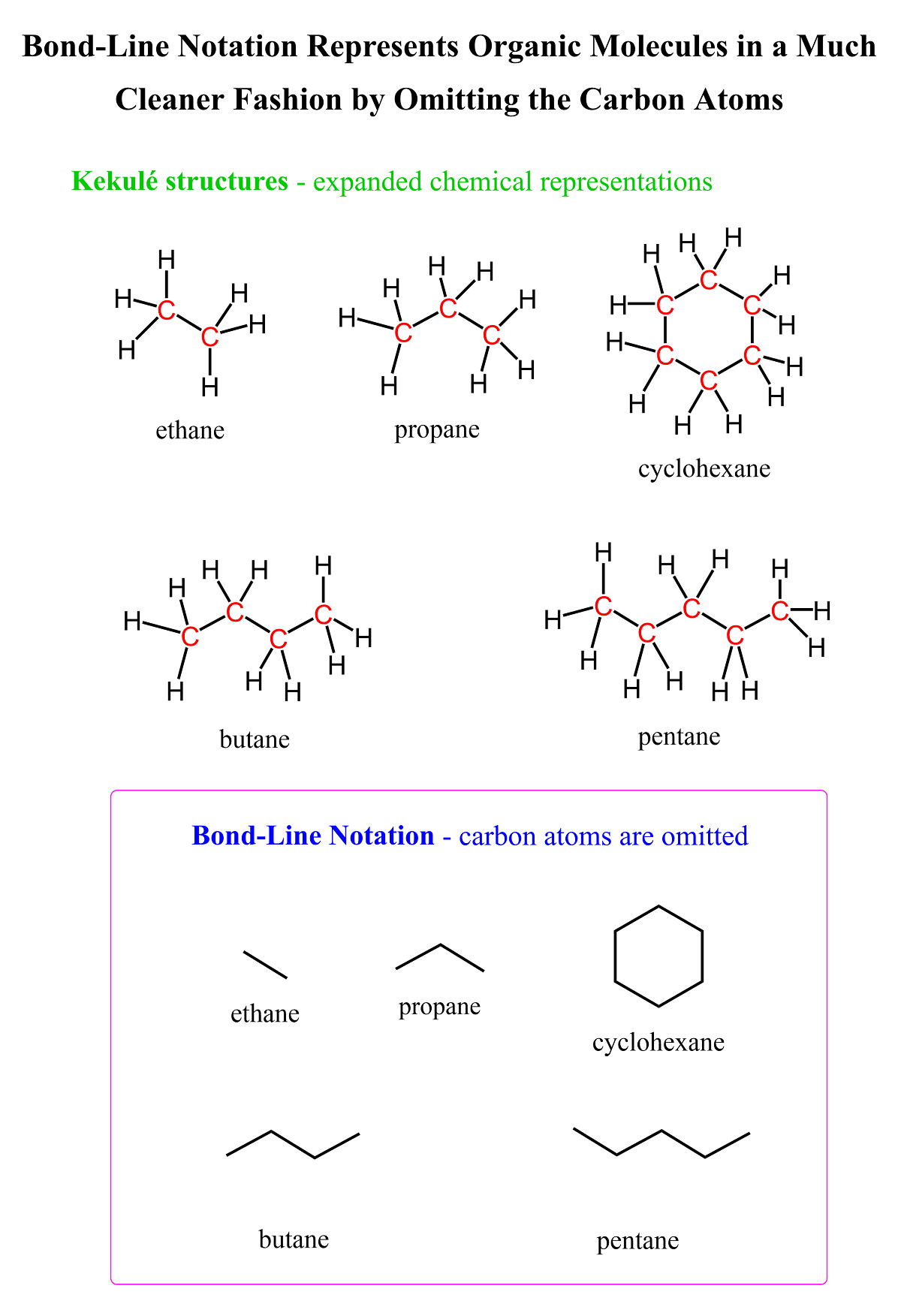
Notice how clean the bond-line representations are, and this is because we omit showing all the carbon atoms and keep in mind that every corner and line end in the bond-line notation implies a carbon atom with the correct number of hydrogen atoms connected to it. We still show the heteroatoms such as oxygen, nitrogen, halogens, etc. A heteroatom means any atom other than carbon:

Here is a dedicated post on the bond-line notation of alkanes and other functional groups combined with practice problems, so feel free to check it out as well.
The Isomerism in Alkanes
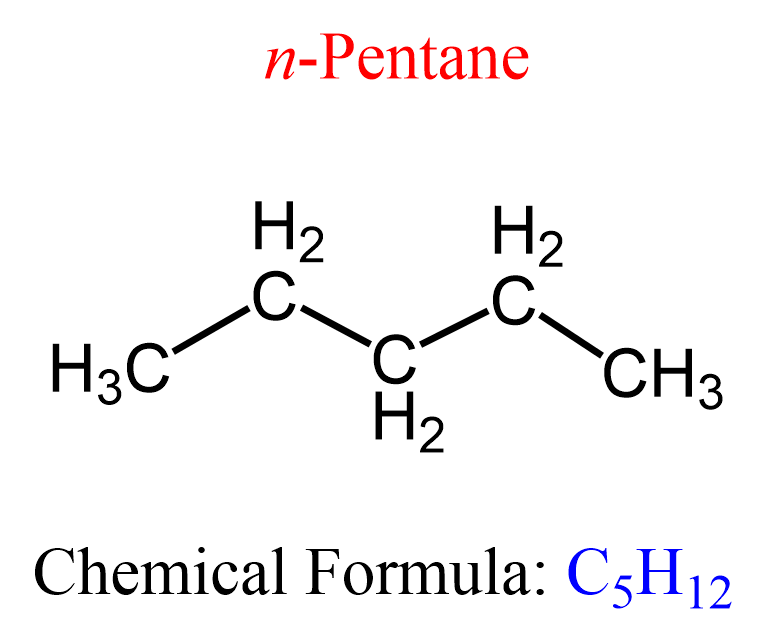
With the increasing number of carbon atoms, it is possible to have more than one structure with a given molecular formula. For example, pentane has a molecular formula of C₅H₁₂, and as we have seen earlier, the structure of pentane is shown by connecting all the carbon atoms in a straight chain with the correct number of hydrogen atoms:
However, there are other ways of connecting these carbon atoms such that the resulting molecule still has the molecular formula C₅H₁₂.
The one we have shown above is therefore called n-pentane, which stands for normal pentane. Aside from this, we also have isopentane and neopentane, and these are called constitutional isomers:
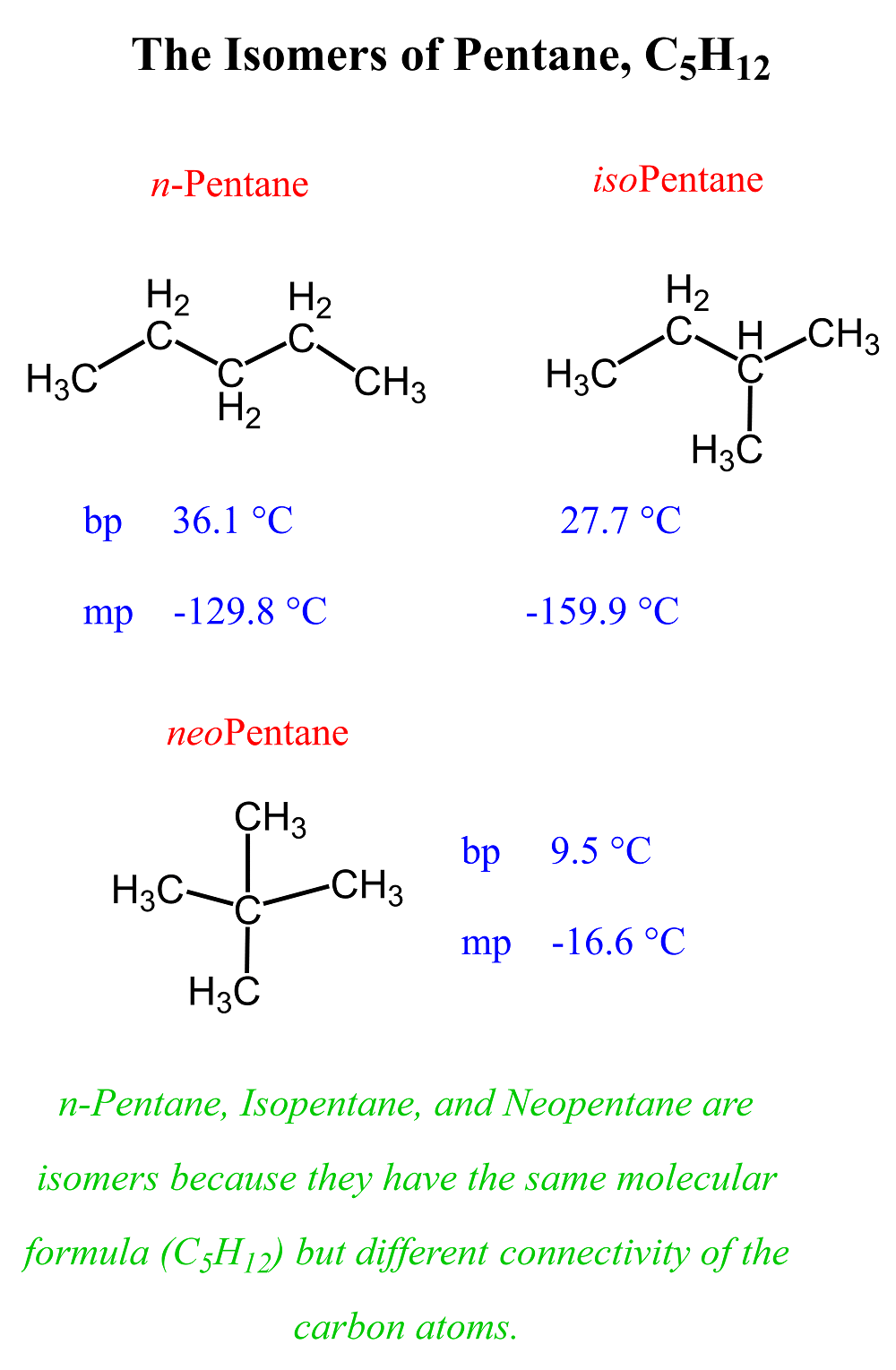
So, once again, constitutional isomers are compounds that have the same molecular formula but different connectivity of atoms.
Check this post on the isomers of pentane and this one for a detailed discussion on constitutional isomers for broader coverage of functional groups in this context.
Notice also that constitutional isomers have different boiling and melting points, and the reason for this is discussed in a separate post dedicated to the boiling and melting points of organic compounds.
Check Also
- Naming Alkanes by IUPAC Nomenclature Rules Practice Problems
- Naming Bicyclic Compounds
- Naming Bicyclic Compounds-Practice Problems
- How to Name a Compound with Multiple Functional Groups
- Primary, Secondary, and Tertiary Carbon Atoms in Organic Chemistry
- Constitutional or Structural Isomers with Practice Problems
- Degrees of Unsaturation or Index of Hydrogen Deficiency
- The Wedge and Dash Representation
- Sawhorse Projections
- Newman Projections with Practice Problems
- Staggered and Eclipsed Conformations
- Conformational Isomers of Propane
- Newman Projection and Conformational Analysis of Butane
- Newman Projection of Chair Conformation
- Gauche Conformation
- Gauche Conformation, Steric, Torsional Strain Energy Practice Problems
- Ring Strain
- Steric vs Torsional Strain
- Conformational Analysis
- Drawing the Chair Conformation of Cyclohexane
- Ring Flip: Drawing Both Chair Conformations with Practice Problems
- 1,3-Diaxial Interactions and A value for Cyclohexanes
- Ring-Flip: Comparing the Stability of Chair Conformations with Practice Problems
- Cis and Trans Decalin
- IUPAC Nomenclature Summary Quiz
- Alkanes and Cycloalkanes Practice Quiz