Cannizzaro Reaction
In the previous post, we talked about the aldol reaction, which occurs when an aldehyde is treated with a base. The role of the base here is to deprotonate the ɑ position of the aldehyde and thus convert it into … Read more
The only way of mastering any topic in Organic Chemistry is doing lots of practice problems. And I know, seeing my students, that starting to work on a practice problem may be the hardest part as you don’t know where to start. It is difficult to visualize what where the double bond would be moved if you follow the five curved arrows crammed in one step. Here is the trick:
We are always told to think before doing something. Fair enough. But let me tell you, it is also strangely enough, that in Organic Chemistry, it is often better to draw and then think about what you did (not in the lab though). It is much easier to have a structure in front of you and check for errors and improvements.
Do the first step, take the pencil and you will see that the ball gets rolling.
You have all these Organic Chemistry Practice Problems waiting to be solved!
In the previous post, we talked about the aldol reaction, which occurs when an aldehyde is treated with a base. The role of the base here is to deprotonate the ɑ position of the aldehyde and thus convert it into … Read more
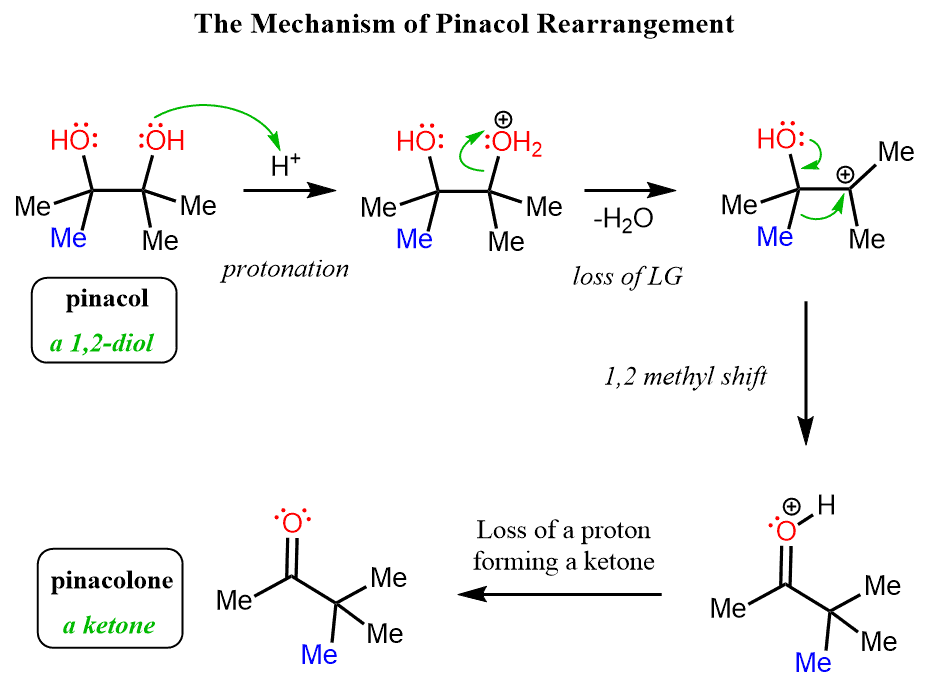
When 1,2-diols (vicinal diols) are treated with acid, a rearrangement takes place, and the diol is transformed to a ketone. This reaction is known as the pinacol rearrangement since pinacol is the simplest diol capable of undergoing such … Read more
Introduction and Nomenclature of Diols In an earlier article, we discussed the nomenclature of alcohols and mentioned that the presence of a hydroxyl group is identified by changing the parent suffix from “e” to “ol”: Now, compounds with … Read more
In the previous post, we talked about optical rotation which is caused by chiral compounds when plane-polarized light passes through their samples. An interesting feature about optical rotation was the discovery that enantiomers rotate the plane-polarized light to an equal … Read more
In the previous post, we talked about the optical activity and the observed rotation. Remember, the observed rotation is the degree and direction to which the plane of a polarized light rotates when passing through a sample of a chiral … Read more
In the previous post, we talked about the intermolecular interactions and their correlation with the physical properties of compounds. The principles of intermolecular interactions are important in estimating the solubility of a given compound. Let’s first define what we understand … Read more
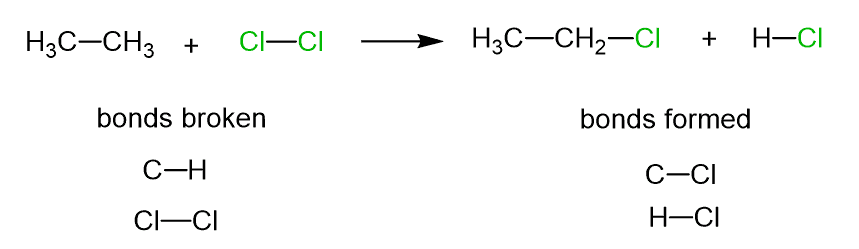
Chemical reactions are rearrangements of atoms as the bonds between them are broken and new ones are formed. For example, in the following reaction, the C-Br bond is broken, and the C-Cl bond is formed: Let’s now compare … Read more
In the previous post, we talked about the main principle of energy, heat and enthalpy associated with chemical reactions. We mentioned, the total change in enthalpy (ΔH°) for the reaction, called the heat of reaction, occurs because of the difference … Read more
In the following few posts, we are going to discuss the scary “enthalpy”, “entropy, and “Gibbs free energy” terms tailored toward organic reactions. The links will take to the topics in general chemistry which you can read to refresh these … Read more
This is a set of practice problems on naming organic compounds. The examples cover the nomenclature of alkanes, bicyclic compounds, alkenes, alkynes, alcohols, alkyl halides, aromatic compounds, aldehydes and ketones, amines, ethers, and carboxylic acid derivatives such as nitriles, esters, … Read more