
We saw earlier that aldehydes and ketones form enolates under basic conditions, which undergo the aldol reaction. The resulting β-hydroxy carbonyl compounds are further dehydrated to give the aldol condensation products, which are usually α,β-unsaturated carbonyl compounds:

A similar sequence of reactions can also occur under acidic conditions, where the ketone or the aldehyde is converted to an α,β-unsaturated carbonyl compound:
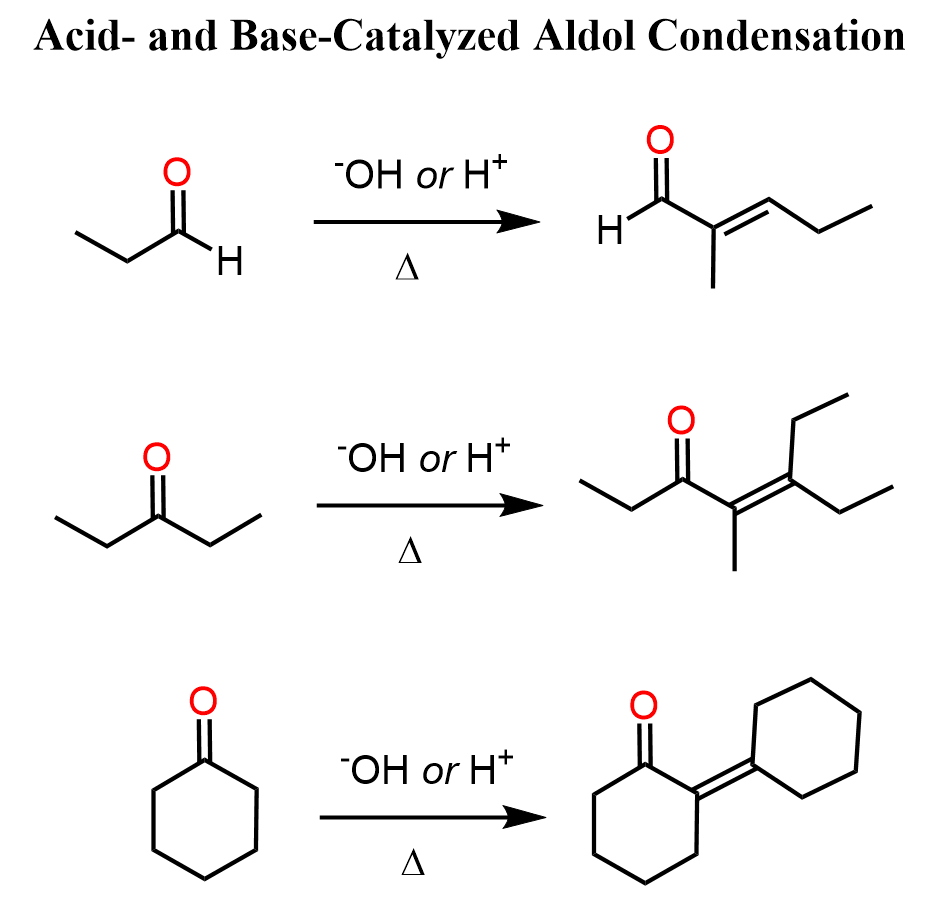
This should not be surprising to us because we know that the nucleophile and electrophile in the aldol condensation are the enolate and the carbonyl compound, respectively. We also know that enols can form under acidic conditions. Recall the keto-enol tautomerization:

So, what prevents the enol from attacking the carbonyl compound like an enolate does?
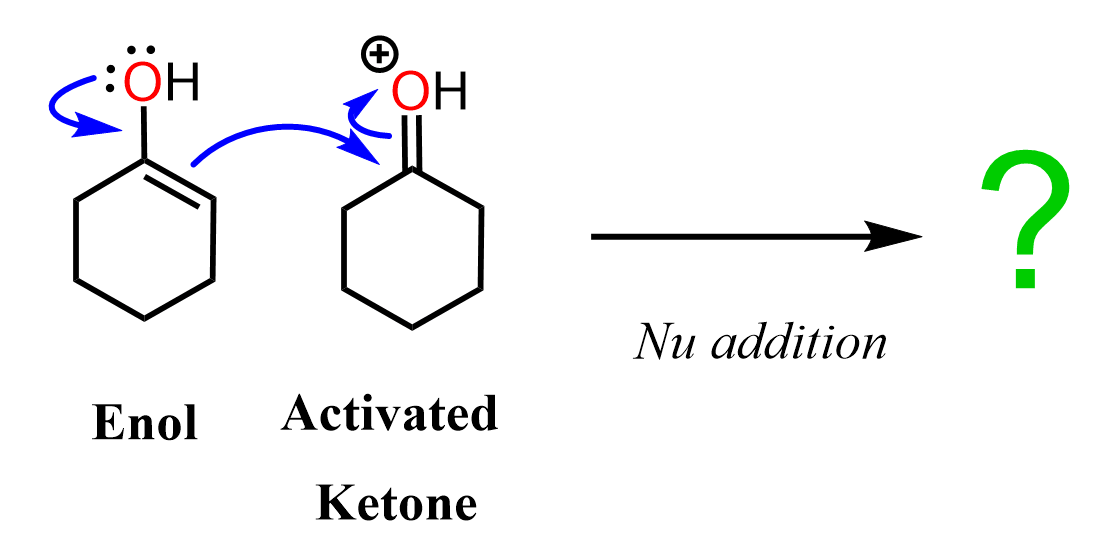
Well, it is true that enolates are more reactive than enols because they carry a negative charge and are therefore more nucleophilic.
On the other hand, unlike in the base-catalyzed aldol condensation, the carbonyl compound is protonated under acidic conditions, which activates it by making it more electrophilic. This allows the less nucleophilic enol to attack it.
Let’s now show the complete mechanism for the acid-catalyzed aldol condensation reaction. It starts with keto-enol tautomerization to form a sufficient amount of enol, which attacks the protonated ketone, and a new C–C bond is formed. After a proton transfer, we have a protonated alcohol, which can undergo an E1 elimination via loss of water, formation of a tertiary carbocation, and subsequent elimination by water:
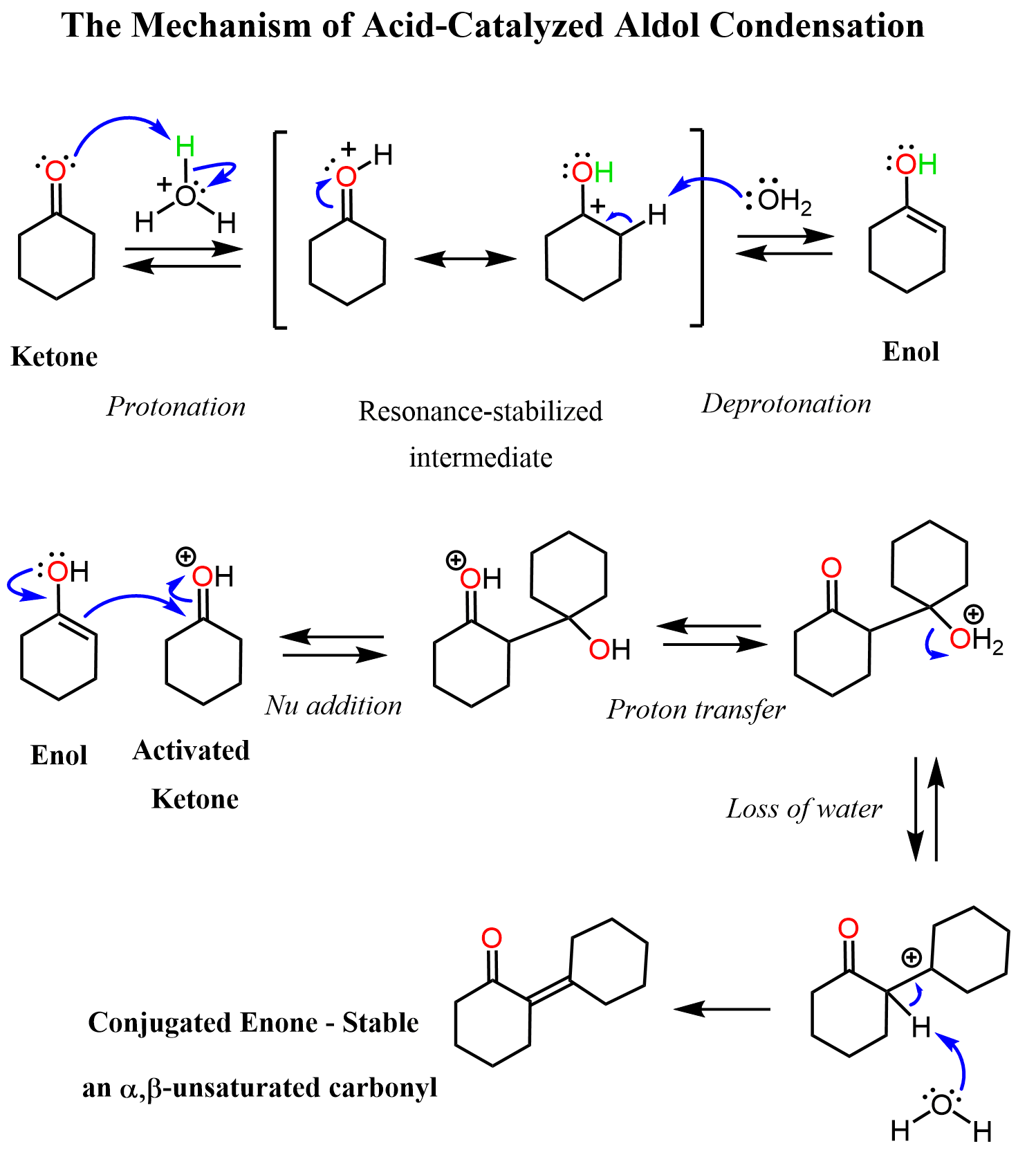
Notice that the elimination takes place at the carbon next to the carbonyl group because this leads to the formation of a conjugated enone, an α,β-unsaturated carbonyl compound. Remember, conjugated systems have additional stability, and this is essentially the driving force of the reaction.
As a side note, remember that the dehydration of the aldol product proceeds via an E1cB elimination under basic conditions.
Racemization
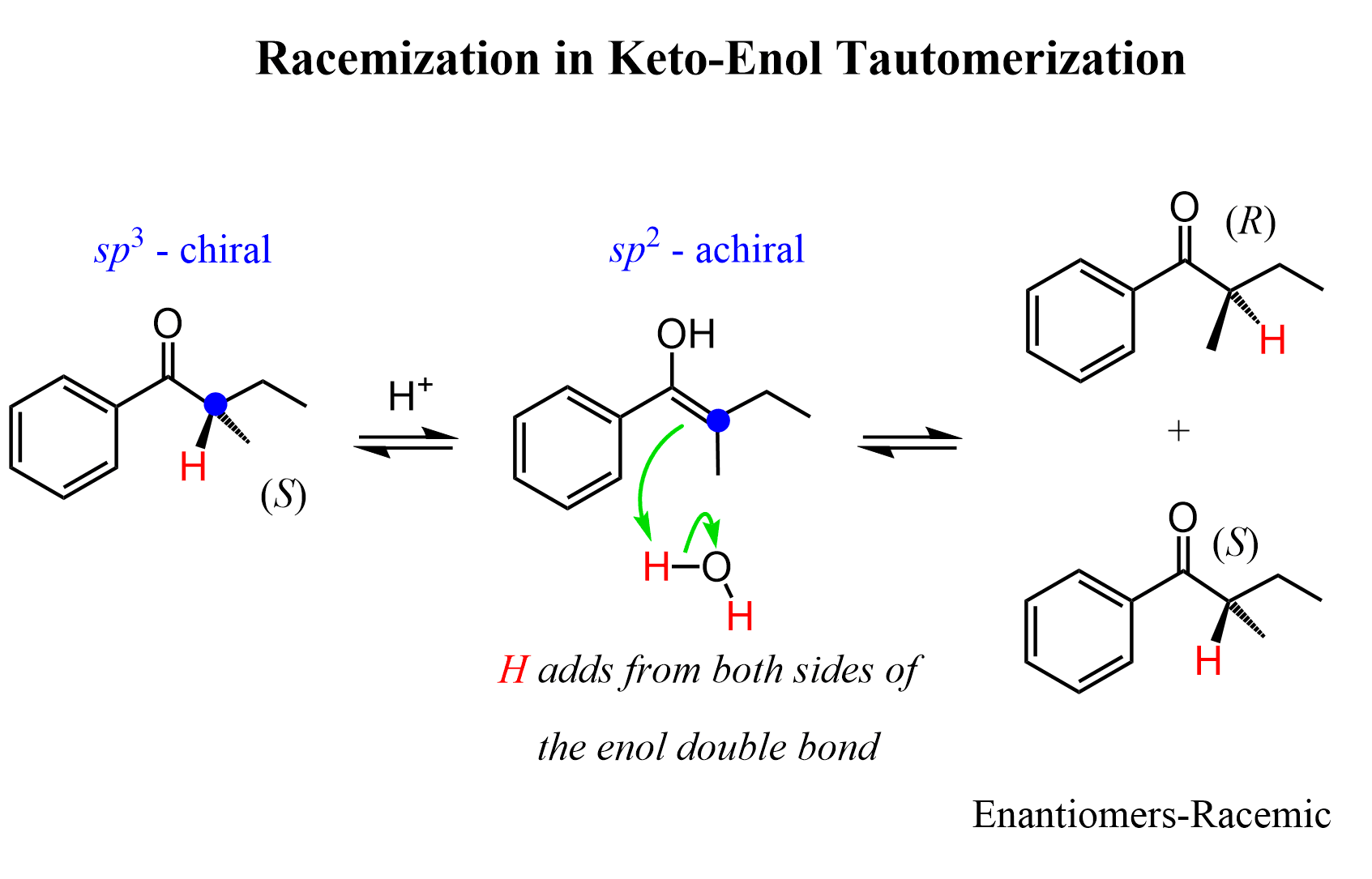
When carbonyl compounds with chiral α-carbons are used, acid- or base-catalyzed keto-enol tautomerization can result in racemization of the chiral center(s). This is because, in both enols and enolates, the α-carbon is sp2-hybridized and therefore planar. When the enol or enolate reacts with an electrophile, including a proton, addition can occur from either face of the planar system, regenerating the chiral α-carbon in either configuration. As a result, both enantiomers can form, leading to racemization:
Applications of Acid-Catalyzed Keto-Enol Tautomerization
Aside from the aldol condensation, acid-catalyzed keto-enol tautomerization allows for some other important reactions that you will see in your Organic Chemistry 2 course.
One of them is the α-halogenation of carbonyl compounds:
What happens here is that the enol again acts as a nucleophile and attacks the halogen molecule, breaking the halogen-halogen bond and forming an α-halogenated carbonyl compound, along with a hydrogen halide:
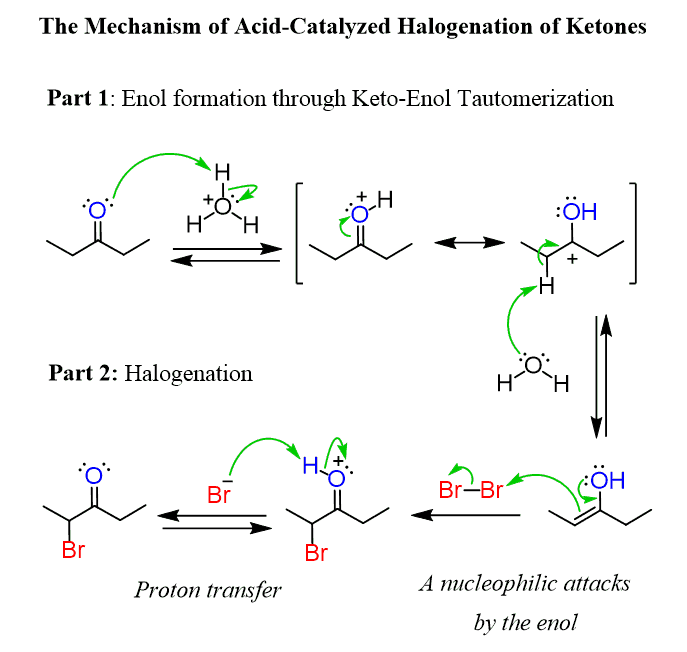
Interestingly, the reaction generally stops at monohalogenation because the presence of the halogen reduces the electron density of the carbonyl group through its inductive effect. This makes the remaining α-hydrogen less readily removed through enolization, slowing down the formation of additional enol.
This is not the case with base-promoted α-halogenation, where the halogen increases the acidity of the remaining α-hydrogens through its inductive effect. This makes the formation of the enolate easier, allowing further halogenation to occur. In fact, methyl ketones can undergo repeated halogenation at the α-carbon until all three α-hydrogens are replaced, leading to the haloform reaction:

Therefore, acidic conditions are generally preferred when monohalogenation is desired, whereas basic conditions can lead to polyhalogenation.
α-Halogenated ketones and aldehydes can undergo further reactions, such as elimination or nucleophilic substitution:

We will cover these reactions in more detail in our dedicated post on the α-halogenation of aldehydes and ketones, which you can find here.
Mannich Reaction
Another important reaction that proceeds through acid-catalyzed enolization is the Mannich reaction, which converts carbonyl compounds into β-aminocarbonyl compounds.
The electrophile in this case is the in situ-generated iminium ion, which is formed by the reaction of an aldehyde (usually formaldehyde) with a primary or secondary amine under acidic conditions. The carbonyl compound first undergoes keto-enol tautomerization, and the resulting enol acts as a nucleophile, attacking the electrophilic carbon of the iminium ion:
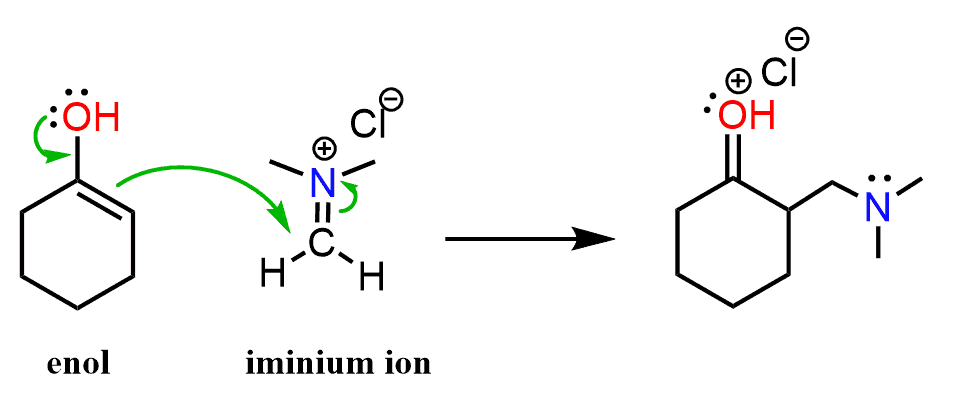
After deprotonation, the β-aminocarbonyl product is formed.
Check Also
- Keto-Enol Tautomerization
- Alpha Halogenation of Enols and Enolates
- The Haloform and Iodoform Reactions
- Alpha Halogenation of Carboxylic Acids
- Alpha Halogenation of Enols and Enolates Practice Problems
- The E1cB Elimination Mechanism
- Aldol Reaction – Principles and Mechanism
- Aldol Condensation – Dehydration of Aldol Addition Product
- Intramolecular Aldol Reactions
- Aldol Addition and Condensation Reactions – Practice Problems
- Crossed Aldol And Directed Aldol Reactions
- Crossed Aldol Condensation Practice Problems
- The Cannizzaro reaction
- Alkylation of Enolates at the Alpha Position
- Enolate Alkylation Practice Problems
- Acetoacetic Ester Synthesis
- Acetoacetic Ester Enolates Practice Problems
- Malonic Ester Synthesis
- Decarboxylation
- Michael Reaction: The Conjugate Addition of Enolates
- Robinson Annulation, Shortcut, and Retrosynthesis
- Claisen Condensation
- Dieckmann Condensation – An Intramolecular Claisen Reaction
- Crossed Claisen and Claisen Variation Reactions
- Claisen Condensation Practice Problems
- Stork Enamine Synthesis
- The Reformatsky Reaction
- Mannich Reaction
- The Knoevenagel Condensation
- Enolates in Organic Synthesis – a Comprehensive Practice Problem